


Definition
Genre conventions are the recurring elements (scenes, character roles, settings, structures and endings) that readers of a genre expect, and whose absence makes a book feel like it belongs somewhere else.
A convention is defined by the reader, not the writer. Romance readers expect the central couple to end up together; that expectation is so strong the genre's own trade definition includes it. Mystery readers expect a solvable puzzle; in 1929 the crime writer Ronald Knox published ten "commandments" of detective fiction, mostly about playing fair with clues, and readers still enforce the spirit of them.
Conventions are not formulas. They tell you what must happen, never how. Two romances can both hit every convention and read nothing alike, because the execution, the voice and the specific people are yours.
Conventions, tropes and clichés are different things
Writers mix these up constantly, and the confusion leads to bad decisions, like cutting a required scene because it "feels cliché".
| Term | What it is | Example | Optional? |
|---|---|---|---|
| Convention | An element the genre requires | The detective identifies the culprit | No |
| Trope | A popular pattern you can choose | Enemies to lovers | Yes |
| Cliché | A trope or line executed on autopilot | "It was all a dream" | Avoid |
Tropes are menus; conventions are the meal. For a menu of the popular romance options, see our romance tropes guide.
Conventions by genre
Pick a genre to see the promise it makes, the scenes readers wait for, and the mistake that earns one-star reviews.
The promise
Two people fall in love, the relationship is the main plot, and the ending is emotionally satisfying and optimistic.
Expected elements
The meet-cute or first meeting; a growing attraction with real obstacles; a dark moment where the relationship seems lost; a grand gesture or proof of change; a happily ever after or happy for now.
The one-star mistake
A tragic or open ending. Readers shelve it as women's fiction or literary fiction at best.
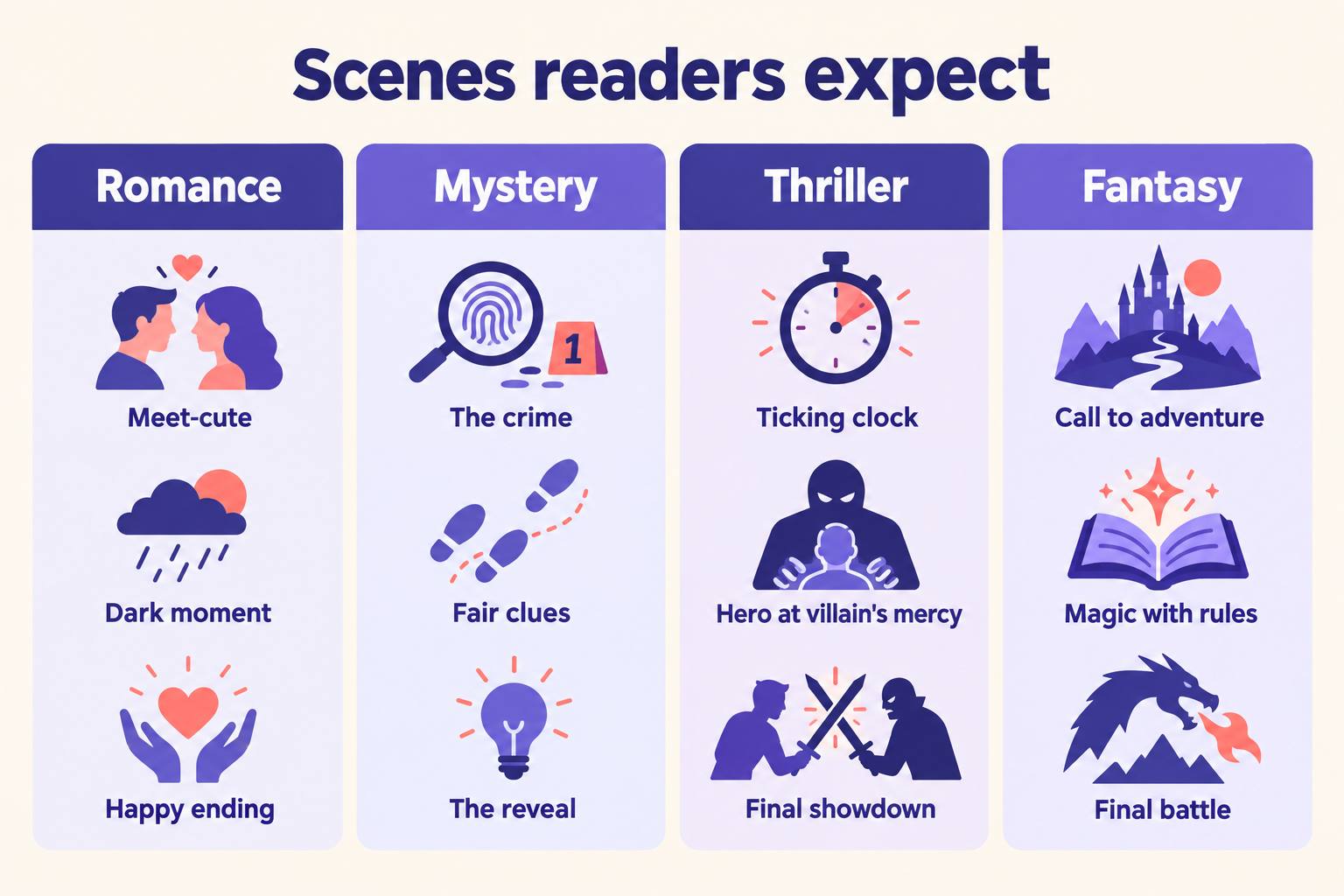
Each genre has its own deep guide: writing a mystery novel, writing a thriller, writing a fantasy novel and writing a romance novel.
How to use conventions without sounding generic
The craft lives in the gap between what readers expect and how you deliver it. Four techniques work across genres.
Deliver the scene, change the shape
The reveal must happen, but it can happen in a kitchen instead of a drawing room, or be delivered by the least likely character. Readers want the scene, not the staging they have seen before.
Make the convention cost something
A fantasy climax that uses the magic system's established price feels earned. Our guide to magic system rules shows how to set that price early.
Plant the expectation, then exceed it
Mystery readers expect a twist. Give them the expected one, then a second that recontextualizes it. The free plot twist generator is useful for brainstorming the second layer.
Map conventions onto structure before drafting
Decide in the outline where each required scene lands, so none is forgotten and none arrives too late. A beat sheet pairs well with a genre checklist.
Common mistakes
- Cutting a required scene because it feels obvious. Obvious to you after six drafts is satisfying to a reader on first read.
- Mixing genre promises without choosing a primary one. A romantic thriller must still be one of the two first, or both audiences feel shortchanged.
- Treating conventions as a checklist to tick in order. They are beats to land at the right emotional moment, not boxes on page 50.
- Marketing a book as a genre whose conventions it does not keep. Covers, categories and blurbs promise conventions too.
When breaking a convention works
Breaking a convention is a deliberate trade: you lose some genre readers to gain a specific effect. It works when the break is the point of the book and the marketing tells readers in advance. Gone Girl broke the reliable-narrator expectation of the crime novel, and its marketing leaned into the twist rather than hiding it.
It fails when it is accidental, or when the book is sold as a straight genre title. If you plan to break a convention, ask whether your book is actually a different genre, or sits closer to literary fiction. Our guide to genre fiction vs literary fiction helps you decide where it belongs.
Using AI to keep conventions on track
Conventions are easy to lose in a long draft, and easy to check in an outline. When you set up a book in AIWriteBook you pick up to four genres and the subgenres that fit, which tells the AI what kind of story it is drafting. The outline builder then gives you an editable chapter-by-chapter plan, so you can check against your genre's list before you write a word, and add the dark moment or the reveal if it is missing. You can then edit any chapter in the AI chat, accept or reject each suggested change, and keep the scene the way you want it.
For a single tricky scene, the free scene builder drafts options you can compare against your genre's expectations.
Outline a book that keeps its genre promise
Pick your genres, get an editable chapter outline, check it against the scenes readers expect, and draft it in your own voice.
Genre conventions FAQ
They are the elements readers expect from a type of story: the happy ending in romance, the solvable crime in a mystery, the escalating danger in a thriller. If they are missing, the book feels like it is in the wrong section.
No. A convention is required for the genre; a trope is an optional, recognizable pattern. Enemies to lovers is a trope you can choose; the couple ending up together is a convention of romance.
Yes, though they are looser: an emphasis on interior life, ambiguity tolerated in the ending, and prose style as a central pleasure. Readers notice when those are missing too.
Read ten recent bestsellers in your exact subgenre and list the scenes they share, then read their one-star reviews. Complaints like "the ending came out of nowhere" show you which expectation was broken.
Keep the promise, own the delivery
Genre conventions are the contract that lets readers pick up a book by a stranger with confidence. Keep the contract and you earn the freedom to surprise them everywhere else.
Explore subgenres, tropes and structure in our genre fiction guide.