


In this guide
Why Goodreads still matters
Goodreads is where a large share of committed readers keep their to-read list. That list is the asset. When a reader shelves your book, their friends see it in their update feed, and the book page counts it in its Want to Read number, which is the first thing a browser notices before they read a single review.
It is also a platform you cannot opt out of. Your books get a Goodreads page whether you claim it or not, built from Amazon and library data, and readers rate them there. Claiming the profile is how you fix the wrong cover, the missing series link and the bio that reads like a stranger wrote it.
What changed recently is the rating rules. In 2026 Goodreads tightened pre-publication ratings so that a reader has to mark the book as read or currently reading and say how they got a copy, such as an ARC or a giveaway, before rating it. A formal Did Not Finish shelf now separates abandoned books from low stars. Both changes reward books that reach the right readers early and punish broad, untargeted early exposure.
The program in four numbers
$0
to join the Author Program
2 days
typical approval time, in business days
$119
Standard giveaway package
100
maximum copies per giveaway
Claim your author profile in five steps
Tick each step as you go. The application is short, but the profile you build right after approval is what readers actually see.
0 of 5 steps done
The bio box is where most authors stall. Write it in third person, open with what you write rather than your day job, and keep it under 120 words. If you want a few versions to choose from, the free author bio generator gives you short and long variants you can trim for Goodreads, Amazon and your own site.
The author dashboard, tool by tool
After approval, your profile gets an author badge and a dashboard. Pick a tool to see what it is good for and how much time it deserves.
What it is
Photo, bio, website, genres, influences and the books you list as favorites.
Is it worth your time
Worth 30 minutes once. Readers who click your name from a book page decide in a few seconds whether you look like a working author.
Tip
List three or four favorite books in your own genre. Readers who shelved them find you through them.
Giveaways and their 2026 pricing
Goodreads has charged for giveaways since 2018. In 2026 there are still two packages, and both let you give away up to 100 copies.
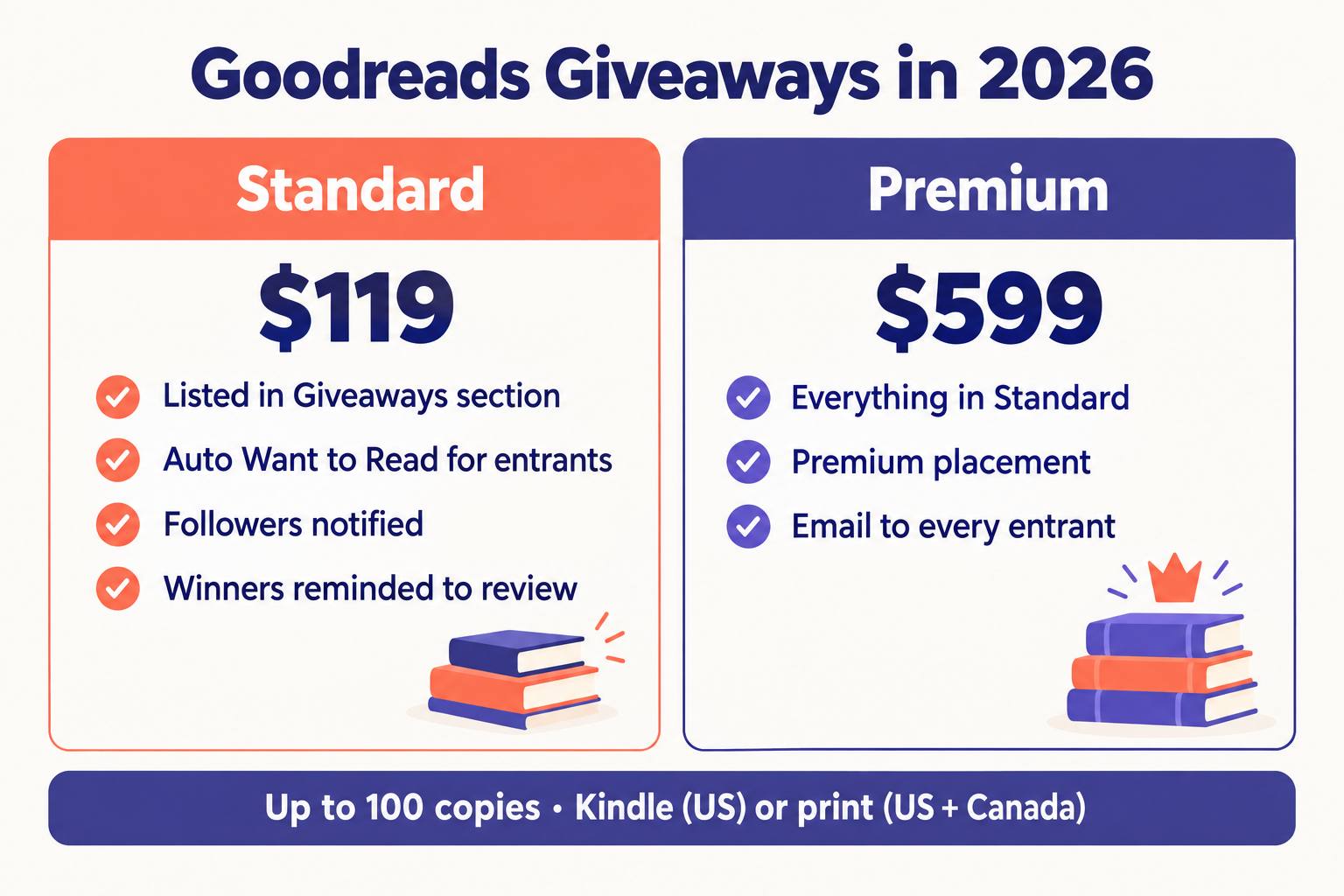
| Standard | Premium | |
|---|---|---|
| Price | $119 | $599 |
| Listing in the Giveaways section and on your book page | Yes | Yes, with premium placement |
| Every entrant's Want to Read shelf | Yes | Yes |
| Notification to your followers | Yes | Yes |
| Review reminder emails to winners | Yes | Yes |
| Your own follow-up email to everyone who entered and did not win | No | Yes |
Two formats sit inside either package. Kindle giveaways are for books published through KDP and already on the Kindle Store; Goodreads delivers the ebooks and you pay nothing per copy, but only US residents can enter. Print giveaways are open to any publisher, US and Canadian readers can enter, and you buy and ship the copies yourself.
The Premium email is the only feature that is genuinely different, and it is only worth $480 extra if you have a strong offer to put in it, such as a discounted launch price, a free prequel or a sample chapter. Without one, Standard does the same job.
Giveaway cost calculator
Plug in your own numbers, then come back after the giveaway and add what you got. The defaults come from author Kris Maze's ten-paperback Standard giveaway, written up in September 2026: 4,299 Want to Read adds and 11 ratings.
Total spend
$239
Cost per Want to Read
$0.06
Cost per rating
$21.73
Read the two results side by side. Giveaways buy shelves cheaply and ratings expensively. Judge them by the first number and get your ratings from ARC readers and your list instead.
What actually moves sales
Goodreads rarely produces a sales spike you can trace. It works as a chain, and each link has to hold.
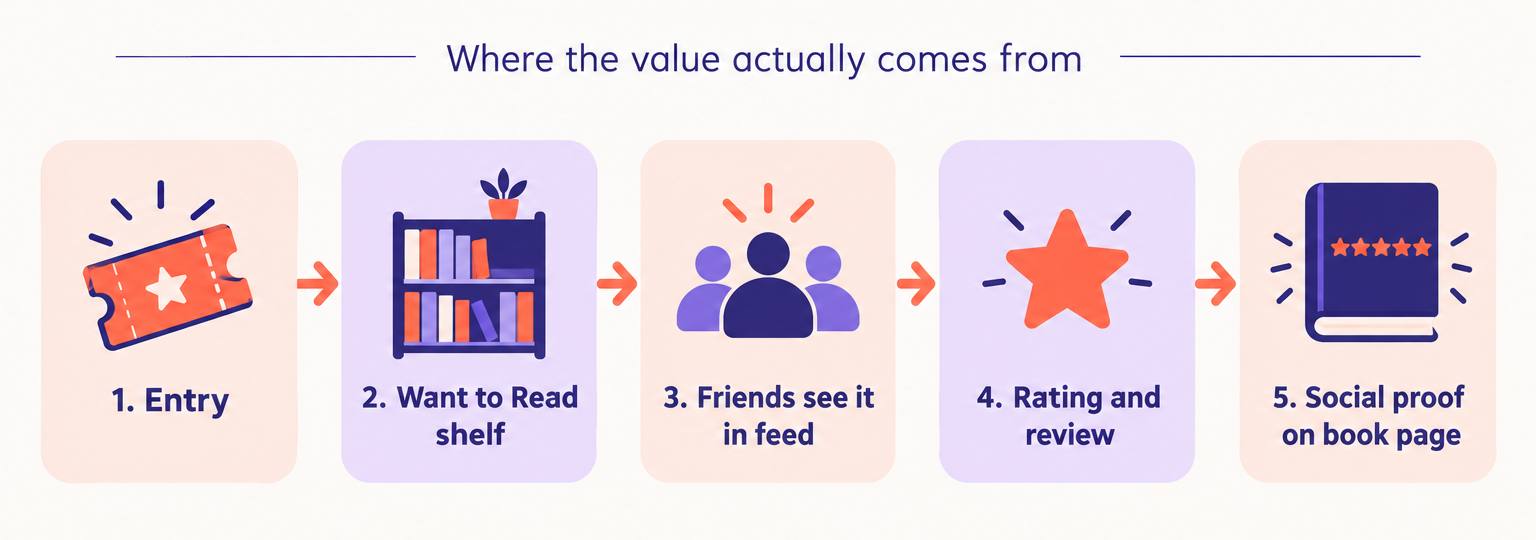
Pre-launch shelves
A shelf added before launch becomes a release-day nudge. This is the highest-leverage use of a giveaway, and the reason to run it weeks ahead.
Early ratings from the right readers
Under the 2026 rules, early ratings have to come from people who actually read the book. ARC readers do that well. A focused ARC push through NetGalley or your own team beats a giveaway for ratings.
A complete series page
Series readers live on Goodreads. A clean series page with every volume in order quietly sells book two to everyone who finishes book one.
Pairing Goodreads with a price event
Shelves turn into purchases when something happens: launch day, a Kindle Countdown Deal or a BookBub feature. Readers who shelved the book months ago respond to the drop.
Notice what is missing: posting in groups, following thousands of readers, and answering reviews. None of those move numbers, and the last one can hurt you.
Goodreads followers belong to Goodreads
AIWriteBook gives you a public author page you can switch on, with your bio, every book you have published and an email capture, so readers who find you on Goodreads can join a list you own and hear from you directly when the next book launches.
Common mistakes
Tap a mistake to see the fix.
Copy-ready templates
Adapt these to your book. The giveaway text is what entrants read on the listing, so lead with the hook, not the logistics.
Giveaway description
[One-sentence hook: who the hero is and what they stand to lose.]

[Two sentences on the central conflict and the tone: cozy, dark, funny, sweeping.]

For readers who loved [comparable title 1] and [comparable title 2].

[Number] signed paperbacks up for grabs before the [month] release. Shelve it now and you will hear the moment it goes live.
Ask the Author starter questions
1. What made you want to write [book title]?
2. Which character was the hardest to write, and why?
3. Is [book title] part of a series, and what order should I read it in?
Note to giveaway winners
Hi [name], your copy of [book title] is on its way. I hope it keeps you up past bedtime. If it does, a short rating on Goodreads helps other readers find it more than anything I can do myself. Thank you for entering.
Need the longer version for an ARC team invite or a review request email? The free review request generator drafts both, and the book launch email sequence tool writes the launch emails that turn shelved readers into buyers.
Goodreads Author Program FAQ
Yes. Claiming your profile and using the dashboard, Ask the Author and the blog cost nothing. Only giveaways are paid: $119 for Standard and $599 for Premium in 2026.
Yes. Forthcoming books in the Goodreads database count, so you can claim your profile and set up a pre-launch giveaway before release day.
No. For KDP books the ebook copies are delivered by Goodreads at no book cost, but entry is limited to US residents. Print giveaways open to the US and Canada, and you pay for and ship the books.
Some, but not many. Giveaways reliably build Want to Read shelves. Ratings come more dependably from ARC readers who agreed in advance to read and review.
The old self-serve ad tool was shut down. Goodreads advertising now runs through direct sales with high minimums, so for most indie authors the giveaway is the only paid tool worth using.
As an approved author you can edit your own book details. For combining editions or creating a series page, post the ISBNs in the Goodreads Librarians Group and a volunteer librarian will fix it.
The short version
Claim the profile, fix every book page, connect the blog you already have and seed Ask the Author. Then spend $119 on a Standard giveaway four to eight weeks before launch and measure it by shelves, not reviews. Get your early ratings from ARC readers, and keep a list of your own so the readers you meet on Goodreads can hear about the next book.
Goodreads is one channel among several. Your Amazon Author Central profile, your launch plan and your review strategy all feed the same launch week.
For the rest of the launch toolkit, see the full Book Marketing guide.