


Why readers skip info dumps
Learning how to avoid info dumping starts with knowing why it fails. Readers do not hate information. They read eight-hundred-page fantasy novels and dense legal thrillers for fun. What they skip is information they did not ask for, delivered while nothing is happening.
An info dump fails on two counts at once. The story's clock stops, because no one in the scene is wanting, doing or losing anything while the paragraph runs. And the reader's curiosity is answered before it existed, so the fact has nowhere to land. A detail that would have been a revelation on page two hundred is homework on page two.
Under both is a writer's anxiety: the fear that the reader will be lost without the history of the war, the rules of the magic, the protagonist's childhood. Readers are much better at tolerating uncertainty than writers think. Mild confusion, carried by a character who knows what they want, is what makes people turn pages.
The seven-symptom check
Pick a passage you suspect and tick every symptom it shows. Be honest; the point is to find the paragraphs worth rewriting first.
Symptoms ticked: 0 of 7
Tick the symptoms that apply to your passage.
The need-to-know filter
Every piece of exposition you are tempted to write can go through three questions, in this order. The answers tell you whether to cut it, delay it, compress it or stage it.
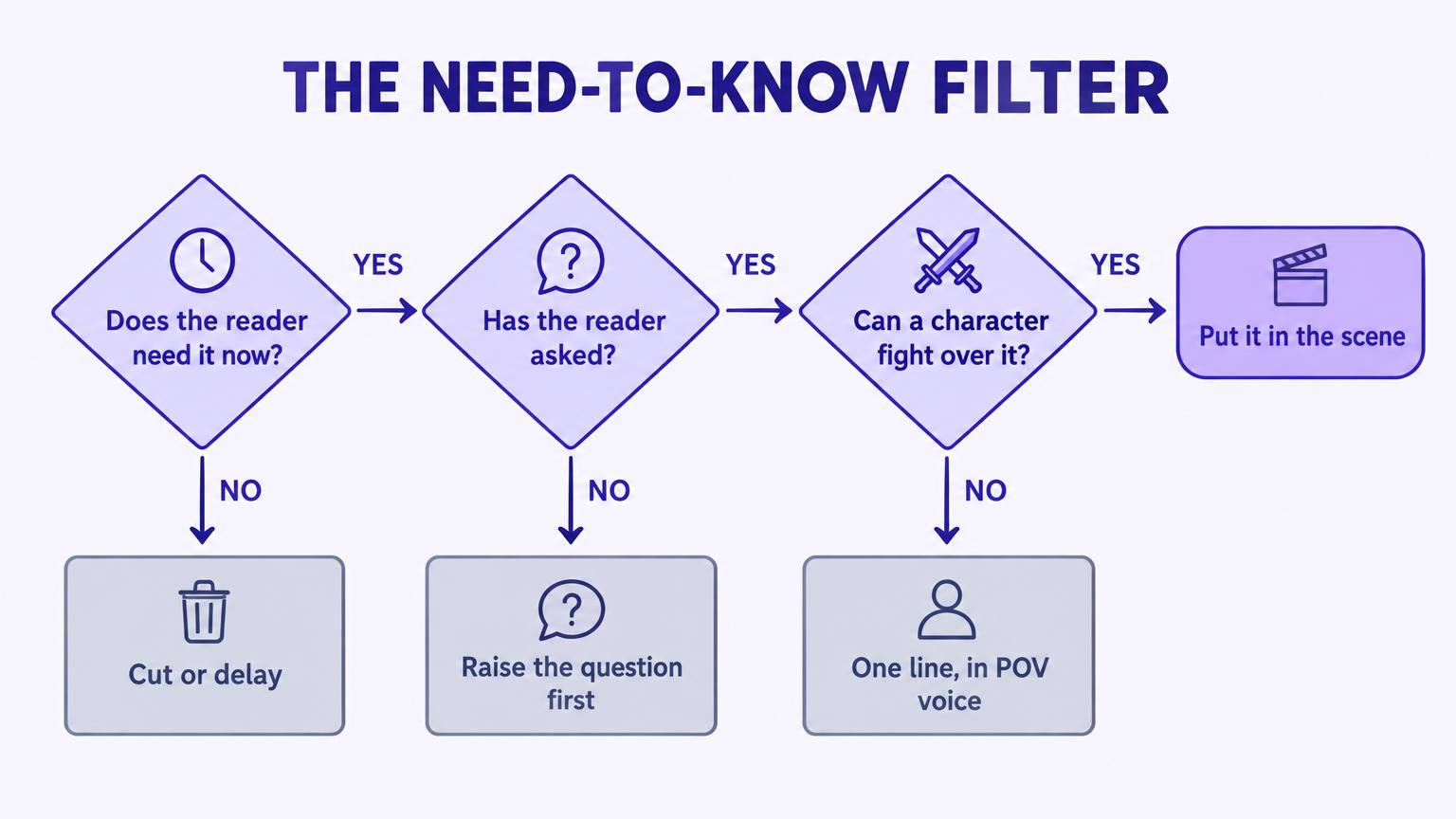
Does the reader need it now?
Not eventually, now, to understand what is happening in this scene. If not, cut it or move it later. Most backstory fails here, and most of it never needs to come back.
Has the reader asked?
Has the story made them wonder? If the answer is needed but the question has not been raised, raise the question first: show the scar, the locked door, the name nobody says. Then answer, a few pages later.
Can a character fight over it?
If two people in the scene can disagree about the fact, want different things from it, or use it against each other, stage it as conflict. If not, compress it to one line in your viewpoint character's voice and move on.
Six techniques that replace an info dump
1.Conflict-driven exposition
Deliver information as an argument, a negotiation or a threat. When a smuggler explains the border patrol schedule to a nervous client who is trying to haggle down the price, the reader learns the schedule because two people want different things from it. Exposition inside conflict reads as plot.
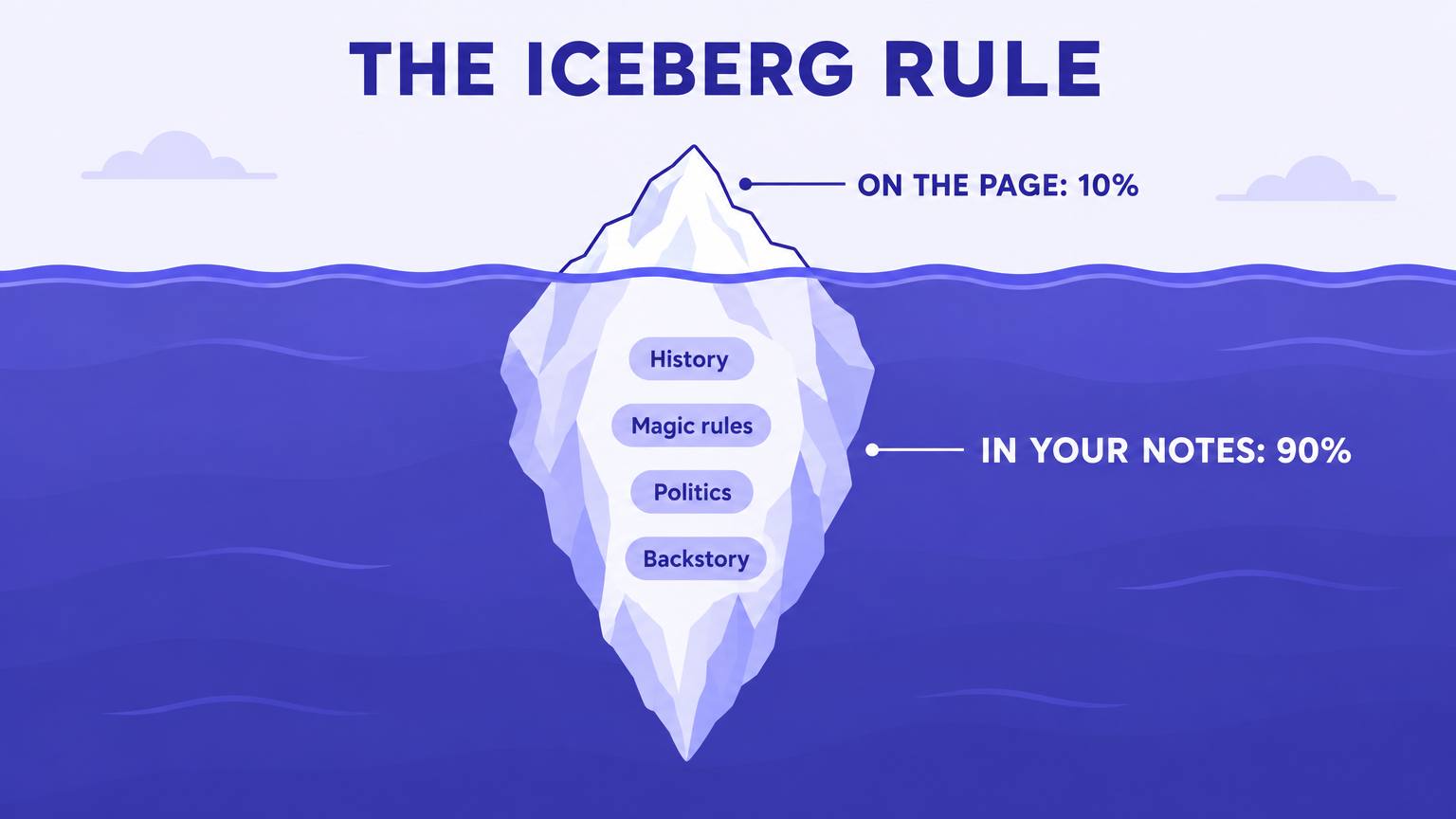
2.The iceberg rule
Know far more than you show. Write the full history of your kingdom in your notes, then let roughly a tenth reach the page, in the places where characters actually bump into it. The other nine tenths are not wasted: they are why the visible tenth feels solid. Our worldbuilding guide covers how to build the part under the water.
3.Question before answer
Never answer a question the reader has not asked yet. Plant the mystery first, then delay the explanation as long as the reader's patience allows. The gap between the two is tension, and tension is the reason people keep reading.
4.Filter it through a point of view
Facts in an encyclopedia voice are a dump. The same facts with an opinion attached are characterization. Not "the city had been founded three hundred years earlier" but "three hundred years, and the city still smelled like the swamp it was built on". The viewpoint character's bias does the work.
5.Let action carry it
Show the rules by having someone use them, break them or pay for them. A reader learns more about your magic system from one spell that goes wrong than from three pages describing how it should go right. This is show, don't tell applied to worldbuilding.
6.Use in-world artifacts, sparingly
A letter, a wanted poster, a court transcript or a chapter epigraph can hold information that would be clumsy in narration, and readers will accept a lot of it in that form. Keep each one short, and make sure the scene around it still moves.
Dialogue done right: retiring "As you know, Bob"
The most recognizable info dump is two characters telling each other what they both know, purely for the reader's benefit. It has a name, "As you know, Bob", and readers spot it instantly because real people never talk that way.
The dump
"As you know, Captain, the Treaty of Varn ended the war twelve years ago and gave the eastern provinces to the crown, which is why the rebels hate us."
The fix
"Twelve years since Varn, and they still spit when we ride through." The captain didn't look up. "They lost their farms in that treaty. Spit's cheap."
Three rules make the fix work. Give the information to a character who genuinely does not know it, like a newcomer, a child or an outsider. If both characters know it, have them disagree about it rather than recite it. And let them leave most of it unsaid: people allude, they do not summarize. For the wider craft, see our dialogue writing tips, and if you want a sparring partner to test lines against, the free dialogue generator drafts exchanges between two characters you describe.
Before and after: three info dumps rewritten
Each pair uses the same facts. Toggle between them and notice what the rewrite cuts, what it delays, and what it turns into conflict.
The kingdom of Aster had been ruled by the Veil Mages for four hundred years. The Veil Mages drew their power from the moon, which meant their magic was weakest at the new moon, and every month the kingdom held its breath for three nights. Mira was the daughter of a mage, but she had been born without the gift, which was considered a disgrace in her family.
What changed
The four-hundred-year history is gone; the reader does not need it yet. The moon rule survives as behavior (locked doors), and the family disgrace becomes a wound with a person attached.
How much exposition your genre tolerates
There is no single correct ratio. Readers of some genres come for the information; others punish every paragraph of it.
| Genre | Tolerance | Where dumps hide | Best fix |
|---|---|---|---|
| Epic fantasy | High | Prologues, maps, history lessons | Iceberg rule and in-world artifacts |
| Science fiction | High for ideas, low for mechanics | How the technology works | Let the technology fail on the page |
| Thriller | Low | Hero backstory, procedure | Question before answer |
| Romance | Low | Past relationships, family history | Reveal backstory in conversation with the love interest |
| Mystery | Medium | The detective's explanation chapter | Let suspects argue the facts |
Fantasy and science fiction writers get the most leeway and abuse it the most. If you write in those genres, our page for fantasy writers covers how to keep a big world under control across a long book.
A one-afternoon revision pass for info dumps
Run this on a finished draft, not while drafting. Dumps are normal in a first draft; they are often how writers discover their own world.
- 1
Highlight
Go through the manuscript and highlight every paragraph where nothing happens and something is explained.
- 2
Filter
Run each highlight through the three questions. Mark it cut, delay, compress or stage.
- 3
Cut first
Delete everything marked cut. Read the scene again. Most of the time, nothing is missing.
- 4
Delay
Move each delayed fact to the latest point where it is still needed, and plant the question it answers earlier.
- 5
Stage and compress
Rewrite the remaining facts as conflict, action or one line of opinionated narration. Check the first chapter last and hardest; that is where readers decide.
If the dump you are fighting is the opening, our guides on how to start a book and prologues readers don't skip deal with that specific trap. And because exposition is a pacing problem as much as a content problem, the companion piece on pacing in fiction covers how to tell when a slow passage is earning its slowness.
Doing it with AI
Writing with AI can make info dumping worse if you let it, because a model asked to explain the world will happily explain the world. The fix is the same as by hand: keep the lore out of the chapter and give the scene a conflict to carry it.
In AIWriteBook the lore has somewhere to live that is not the prose. The book's details and character sheets hold the background, and each chapter in the outline has its own events, twists and character interactions, so you can decide which fact gets revealed in which chapter instead of front-loading it. The free world builder is a quick way to get the underwater nine tenths written down first; for a multi-book project, our guide to writing a series bible shows how to keep it organized.
For an existing dump, open the chapter and ask the chapter AI chat something specific, such as "turn the paragraph about the treaty into an argument between the captain and the recruit". The proposed edit comes back as a diff, and you accept or reject each change, so the rewrite stays in your voice. The chapter generator page shows how the chapter writer uses your outline and style sample together.
Keep the lore in the bible, not the prose
Plan which reveal lands in which chapter, then draft scenes that carry the information inside the conflict.
The short version
Every info dump is a fact in the wrong place. Cut what the scene does not need, delay what the reader has not asked about, and stage the rest as conflict or compress it into one line of opinion. Do that and your world stops being explained and starts being discovered, which is the experience readers came for.