

The one-line difference
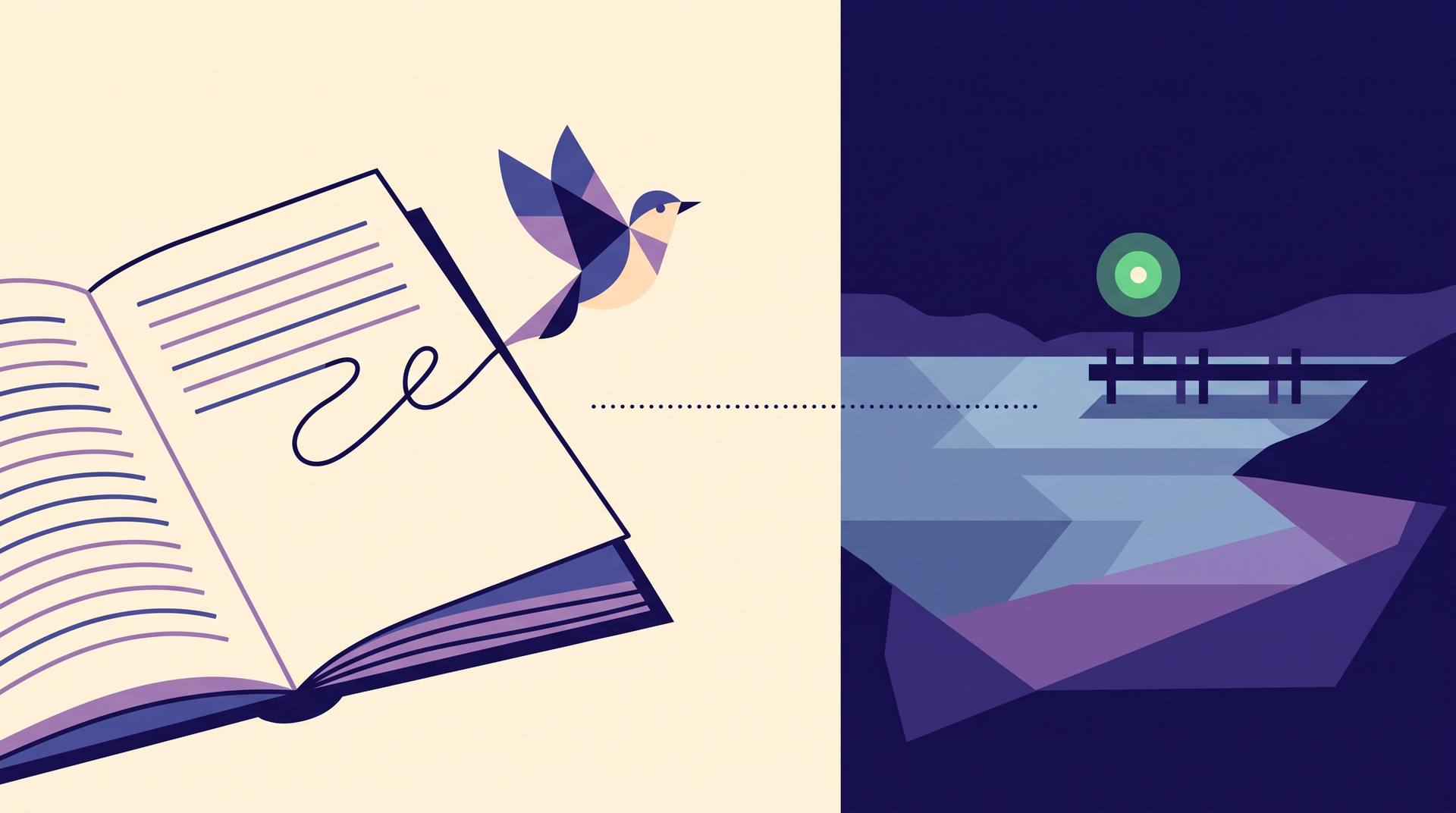
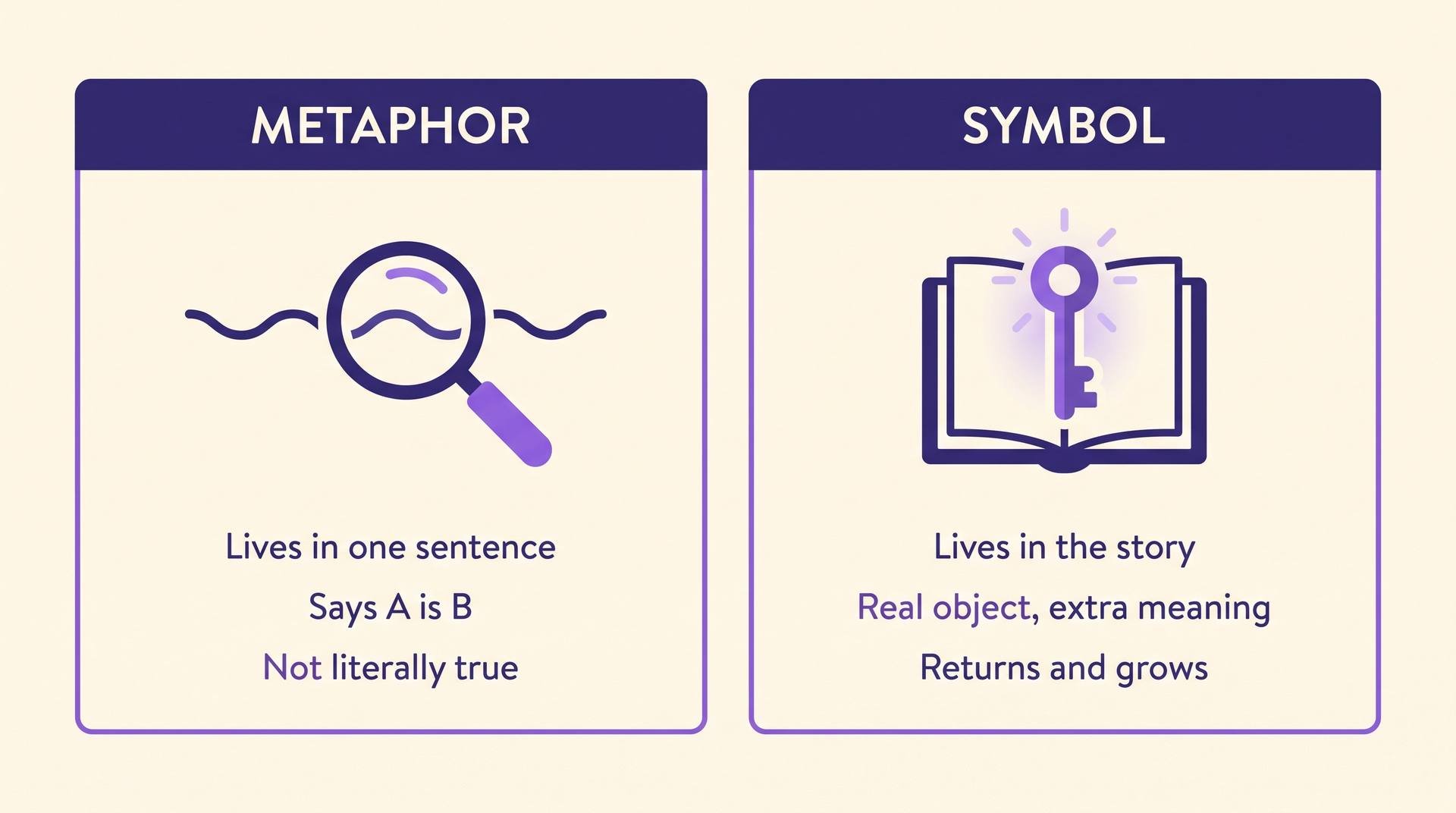
A metaphor says one thing is another thing, and it is not literally true. A symbol is a thing that is literally present in the story and also stands for something larger.
When Shakespeare writes that all the world's a stage, nobody in As You Like It walks onto a literal stage. The claim is figurative and lives entirely in the language. That is a metaphor.
When Fitzgerald puts a green light at the end of Daisy's dock, the light is really there. Gatsby stares at it, reaches toward it, and Nick describes it again at the very end. It is a physical object in the plot that comes to mean longing, money, and a future that keeps moving away. That is a symbol.
So the fastest question to ask is: could a character touch it? If yes, you are probably looking at a symbol. If the comparison only exists in the narrator's phrasing, it is a metaphor.
Symbolism vs metaphor, side by side
The two devices overlap in spirit but differ in scale, placement, and how a reader discovers them.
| Aspect | Metaphor | Symbol |
|---|---|---|
| Where it lives | In a phrase or sentence | In the story world and plot |
| Literally true? | No, it is a figurative claim | Yes, the object really exists in the story |
| How often it appears | Usually once | Repeatedly, often at turning points |
| How meaning builds | Instantly, in one comparison | Slowly, across scenes |
| What the reader notices | The vividness of the language | A pattern they may only see on reflection |
| Delete it and... | The sentence gets plainer | Scenes lose a thread that ties them together |
Quick test: symbol or metaphor?
Pick an answer for each line. The explanation shows the reasoning, which is the part worth keeping.
"Hope is the thing with feathers" (Emily Dickinson)
The conch shell in Lord of the Flies
"Juliet is the sun" (Romeo and Juliet)
The mockingbird in To Kill a Mockingbird
"Time is a thief"
The scarlet letter A on Hester Prynne's dress
Famous examples of each
Seeing the devices in books you know makes the line between them much easier to feel.
All the world's a stage, and all the men and women merely players.
A pure metaphor: life is compared to theater, and the comparison runs only as long as Jaques keeps talking.
Metaphors that stay in the sentence
- Dickinson turns hope into a bird that sings without words and never asks for a crumb.
- Sylvia Plath opens "Metaphors" with a riddle of comparisons for pregnancy, from an elephant to a melon on two tendrils.
- Macbeth calls life a walking shadow and a poor player who struts and frets his hour upon the stage, then is heard no more. No shadow and no player enter the scene; the comparisons live only in his speech.
Symbols that live in the plot
- The green light in The Great Gatsby: a real dock light that becomes the shape of Gatsby's longing.
- The white whale in Moby-Dick: an actual animal the Pequod hunts, loaded with every meaning Ahab projects onto it.
- The conch in Lord of the Flies: a shell the boys use to speak in turn, which breaks as order breaks.
For a longer tour of symbols by type, from colors to weather to objects, see our guide to symbolism in writing. For sentence-level comparisons in bulk, our list of metaphor examples collects dozens you can study.
One object, used both ways
The same image can be a metaphor or a symbol depending on whether it enters the story. Here is a lighthouse doing both jobs in a short literary scene.
Her mother was a lighthouse: steady, bright, and always too far away to reach.
No lighthouse exists in this story. The comparison gives the reader a quick, vivid read on the mother and then disappears. Useful, but its work ends at the full stop.
Notice the symbol version never explains itself. The meaning comes from placement across the book, which is why symbols belong in your plan, not only in your prose. If you plot in advance, mark where a symbol should appear in your outline; the AI outline builder makes it easy to pin an image to specific chapters so it shows up where it should.
Common mistakes
Calling every comparison a symbol
A single striking image is not symbolism. If it appears once and only in the narrator's words, it is a metaphor, and there is no need to inflate it.
Explaining the symbol
"The broken clock represented her frozen grief" kills the effect. Put the clock in three scenes and trust the reader to connect it.
A symbol that never changes
A symbol that means the same thing on page 300 as on page 3 is a label. Let events change how the object looks or how characters treat it.
Mixing metaphors in one breath
"We will nip this in the bud before it snowballs" asks the reader to picture a flower and a snowball at once. Pick one image and let it finish.
Stacking five symbols in one scene
A storm, a dying bird, a cracked mirror, and a red door in the same chapter make readers suspect you of homework. One well-placed object is stronger.
Forgetting the symbol exists
Writers introduce an object with care and then drop it after chapter four. If it matters, it needs a payoff near the climax.
When to use which
You do not need both in every book. Choose by the job you want done.
Reach for a metaphor when
- You need a reader to grasp a feeling or a character fast.
- An abstract idea (fear, grief, time) needs a concrete handle in one line.
- The voice of a first-person narrator should show how they see the world.
Build a symbol when
- Your theme is too large to state directly without preaching.
- You want the ending to echo the beginning.
- A character's change can be shown through how they treat one object.
Skip both when
- The scene is fast action and any comparison slows the reader down.
- The genre favors clean, transparent prose, as in many thrillers and instructional non-fiction.
Using AI to check and strengthen your devices
Symbols are hard to track by hand across a 70,000-word draft, and metaphors are easy to overuse without noticing. This is where an AI editor that can see your whole book earns its keep.
Audit a chapter for tired metaphors
In AIWriteBook's chapter AI chat you can ask for every metaphor in the chapter, flagged as fresh or clichéd, with a replacement suggestion. Each change comes back as a diff you accept or reject line by line, so your voice stays yours. More on how that works on the AI book editor page.
Place a symbol across the plot
Tell the outline the object and the three moments where it should appear. When the chapters are generated or rewritten, the symbol is already in the plan instead of an afterthought you have to patch in later.
Tighten a paragraph without flattening it
If a sentence has two competing images, the free paraphrasing tool gives you alternative phrasings to compare, so you can keep one comparison and drop the other.
Frequently asked questions
A metaphor is a figure of speech that compares two unlike things by saying one is the other, and it is not literally true. A symbol is something that really exists in the story and also stands for a larger idea, usually building meaning over several appearances.
The takeaway
Metaphor works at the scale of a sentence; symbolism works at the scale of the story. One is a flash of language, the other is a thread you plant, return to, and pay off.
When you revise, look at each striking image and ask whether it should stay a one-line comparison or grow into something your characters can hold.
If you are still shaping the book as a whole, our step-by-step guide to writing a book walks through the planning stage where symbols are easiest to seed.