

Why loose prose costs you readers
Readers do not count your words. They feel the drag. A sentence that takes twelve words to do the work of seven makes the reader wait, and a reader who waits starts skimming. Skimmers miss the clue you planted in chapter three and then call the twist in chapter twenty unearned.
On Amazon the cost is visible. The free sample is the first part of your book, and a buyer decides inside a few pages. Flabby opening paragraphs lose that buyer before your story starts. Tight prose is not a style preference here. It is how the sample earns the click on Buy.
Wordiness is also different from ornate writing. If your sentences are long because they are stuffed with adjectives and metaphors, that is purple prose, and it needs a different fix. This guide is about the invisible padding: words that carry no picture and no meaning.
How much to cut
Most authors over-ask. They want to cut a third of the draft and end up gutting the voice along with the filler. A better target for a revision pass is around ten percent. The number comes from a rejection slip Stephen King received as a young writer, and it is still the most useful line-editing rule in circulation.
2nd Draft = 1st Draft – 10%.
For a 90,000-word draft, that is about 9,000 words: roughly one cut sentence per paragraph, not one cut chapter.
Measure before and after. Paste a chapter into the free word counter, write the number at the top of the page, and check it again when you finish. If you cut less than five percent, you were too gentle. If you cut more than twenty, read the chapter aloud: you probably took the voice with the filler.
The four sweeps
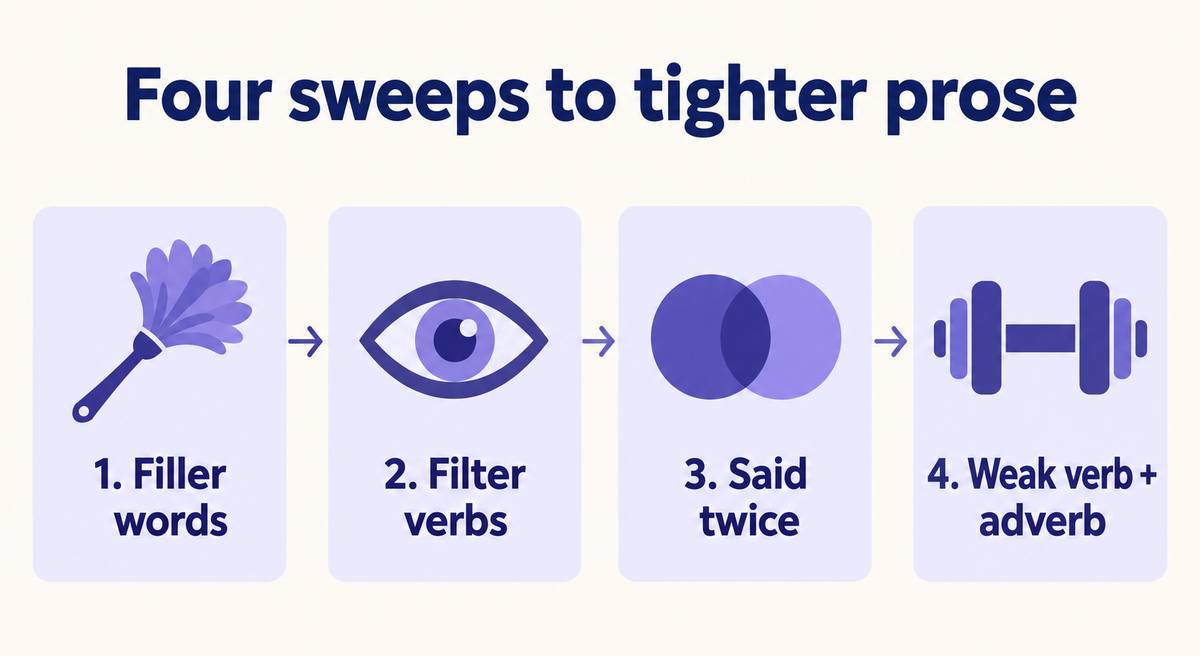
Do not hunt for everything at once. Each sweep looks for one kind of padding, and you can do most of them with your editor's Find function. Four short passes beat one long, tired one.
- 1
Filler words
Search for just, really, very, quite, actually, rather, somewhat, simply and that. Delete each one, then reread the sentence. If the meaning holds, leave it deleted. Test "that" hardest: in "she knew that he lied", it can almost always go.
- 2
Filter verbs
Felt, saw, heard, noticed, realized, watched, wondered, seemed. These put a camera between the reader and the scene. "She heard the door slam" becomes "The door slammed." The reader is already in her head; you do not need to tell them she perceived it. This is where tightening meets show, don't tell.
- 3
Said twice
Look for sentences that make a point and then make it again: "He was furious. He was angrier than he had ever been." Also hunt doubled pairs like each and every, first and foremost, basic fundamentals, and stood up. Keep the stronger half.
- 4
Weak verb plus adverb
"Walked slowly and quietly" is two modifiers propping up a weak verb. Swap the whole cluster for one exact verb: crept. Do the same with started to, began to and was going to, which delay the action they announce.
Before and after, with word counts
Read each original, decide what you would cut, then open the rewrite. The counts show how much a sweep removes without changing what happens.
Fiction, filter verbs and filler
She could feel that her heart was starting to beat really fast as she slowly began to walk toward the door, and she noticed that the handle seemed to be very cold when she finally reached out and touched it with her hand.
Show the tightened version
Her heart raced as she crept toward the door. The handle was cold against her palm.
Removed: could feel that, starting to, really, slowly began to, noticed that, seemed to be, very, finally, with her hand. Nothing the reader sees was lost.
Non-fiction, doubled meaning
In order to fully understand the basic fundamentals of budgeting, it is important to first take a look at where your money actually goes each and every month.
Show the tightened version
Before you budget, track where your money goes each month.
In order to, fully, basic fundamentals, it is important to, take a look at and each and every are all padding. The instruction was hiding in the middle.
Action, weak verb plus adverb
He walked slowly and quietly across the room.
Show the tightened version
He crept across the room.
One exact verb replaced a verb and two adverbs. The rhythm got faster, which is what an action beat needs.
What not to cut: the voice test
Here is the part most tightening guides skip. Some "wordy" text is the voice, and cutting it makes your book sound like everyone else's.
"Well, I mean, I just don't think it's, you know, a good idea," Tom said.
Every hedge in that line is doing work. Tom is nervous, or polite, or lying. Strip it to "It's a bad idea," and you have a different man.
- Dialogue tics that characterize the speaker. Tighten narration hard and dialogue gently.
- A narrator's signature rhythm, such as a long sentence followed by a two-word one. Keep the long one long if the short one needs it.
- Deliberate repetition for emphasis or structure, as in a refrain at the end of each section.
- Sensory detail that the scene's mood depends on. Cut the filter verb, keep the sound itself.
- Close-third thoughts in the character's own phrasing. These follow different rules, covered in our guide to writing internal dialogue.
Tighten by scene type
A single cut rate for the whole book flattens its pacing. Different scenes can carry different amounts of air.
| Scene type | How hard to cut | Why |
|---|---|---|
| Action and fights | Hardest | Short sentences and exact verbs make time feel fast. Any hedge slows the punch. |
| Opening pages | Hard | The sample decides the sale. Every sentence must pull the reader to the next one. |
| Dialogue | Gentle | Cut the tags and beats around speech, not the speech itself. People talk loosely. |
| Reflection and aftermath | Light | Readers need room to feel what just happened. Remove filler, keep length. |
| Description and setting | Medium | Keep one strong detail per beat and cut the rest, especially stacked adjectives. |
Common mistakes when tightening
- Tightening the first draft
- Line edits on chapter one while chapter twelve does not exist yet waste effort, because structural changes will delete half of what you polished. Finish the draft, fix structure, then tighten. The order is laid out in revision vs. editing.
- Turning every sentence short
- Ten five-word sentences in a row read like a list. Tight prose varies its rhythm. Cutting filler should leave long sentences intact when they earn the length.
- Deleting every adverb
- The rule is about adverbs that prop up weak verbs. "She smiled sadly" says something "she smiled" does not, and there may not be a single verb that does the job.
- Global find-and-replace
- Replacing every "just" at once will break the sentences where it means "only" or "fair". Review each hit in context.
Faster with AIWriteBook
The AI-assisted shortcut that keeps your voice
Asking a general chatbot to "make this tighter" usually returns a rewrite in the chatbot's voice. You lose your rhythm along with the filler, and you cannot see what changed.
In AIWriteBook the edit comes back as a diff. Open a chapter, ask the chapter AI chat something specific, such as "cut filter verbs and filler words in this scene, leave the dialogue alone", and every proposed change appears inline to accept or reject one by one. You stay the editor.
For a full manuscript pass, the Book Editor runs line edits chapter by chapter and tags each replacement as objective or subjective, so you can accept the clear fixes quickly and look harder at the taste calls. Because it builds a style sheet first, the same character names and spellings hold across the book.
If the book is still being written, add a sample of your own prose on the writing style step so new chapters start close to your voice and need less cutting later. For a quick check outside the app, the free grammar checker flags wordy phrasing in any paragraph you paste.
Copyable find list
Search for each of these in your manuscript, one sweep at a time. Not every hit should go; every hit deserves a second look.
SWEEP 1: FILLER
just, really, very, quite, actually, rather, somewhat, simply, totally, that

SWEEP 2: FILTER VERBS
felt, saw, heard, noticed, realized, watched, wondered, seemed, could see, could hear

SWEEP 3: SAID TWICE
each and every, first and foremost, basic fundamentals, end result, stood up, sat down, nodded his head, shrugged her shoulders, in order to

SWEEP 4: WEAK VERB + ADVERB
started to, began to, was going to, -ly words after walked, said, looked, moved, went
Questions about tightening prose
What does it mean to tighten prose?
Tightening prose means removing words that add no meaning, image or voice: filler words, filter verbs like felt and noticed, phrases that say the same thing twice, and weak verbs propped up by adverbs. The story and the voice stay; the padding goes.
How much should I cut when I tighten a manuscript?
Around ten percent is a sound target for a revision pass. Under five percent usually means the edit was too timid, and over twenty percent often means voice and rhythm were cut along with the filler.
Should I tighten dialogue the same way as narration?
No. Real speech is loose, and hedges or repetition often characterize the speaker. Tighten the tags and action beats around dialogue, and cut inside the speech only when the words do nothing for the character.
Can AI tighten my prose without changing my voice?
It can if you see and approve every change. Tools that return a whole rewritten paragraph tend to replace your voice. An editor that shows a diff with per-change accept and reject, like the AIWriteBook chapter chat and Book Editor, keeps the final call with you.
Cut the padding, keep the person
Tight prose is not short prose. It is prose where every word you kept is there on purpose. Run the four sweeps, measure what you cut, and protect the lines that only you would write.
Tightening is one stage of a longer process. See where it fits in our step-by-step guide to writing a book.