


The quick answer
A typical novel is 70,000 to 100,000 words, and in a standard paperback that prints as roughly 250 to 400 pages. If you want one number, an 80,000-word novel set in 11-point type on a 5.5 x 8.5 inch page comes out near 282 pages, front and back matter included.
The words are the real measure. Agents, editors and contests ask for word count because it stays the same no matter how the book is set. Pages are what readers see on a product listing, and what a printer charges you for. For the full word-count picture by genre, see our guide to how many words are in a novel.
- printed pages in most novels
- 250–400
- words on a typical paperback page
- ~300
- manuscript pages for 80,000 words
- 320
What counts as a page
When writers ask how many pages a novel should be, they usually mean one of three different things, and mixing them up is where most of the confusion starts.
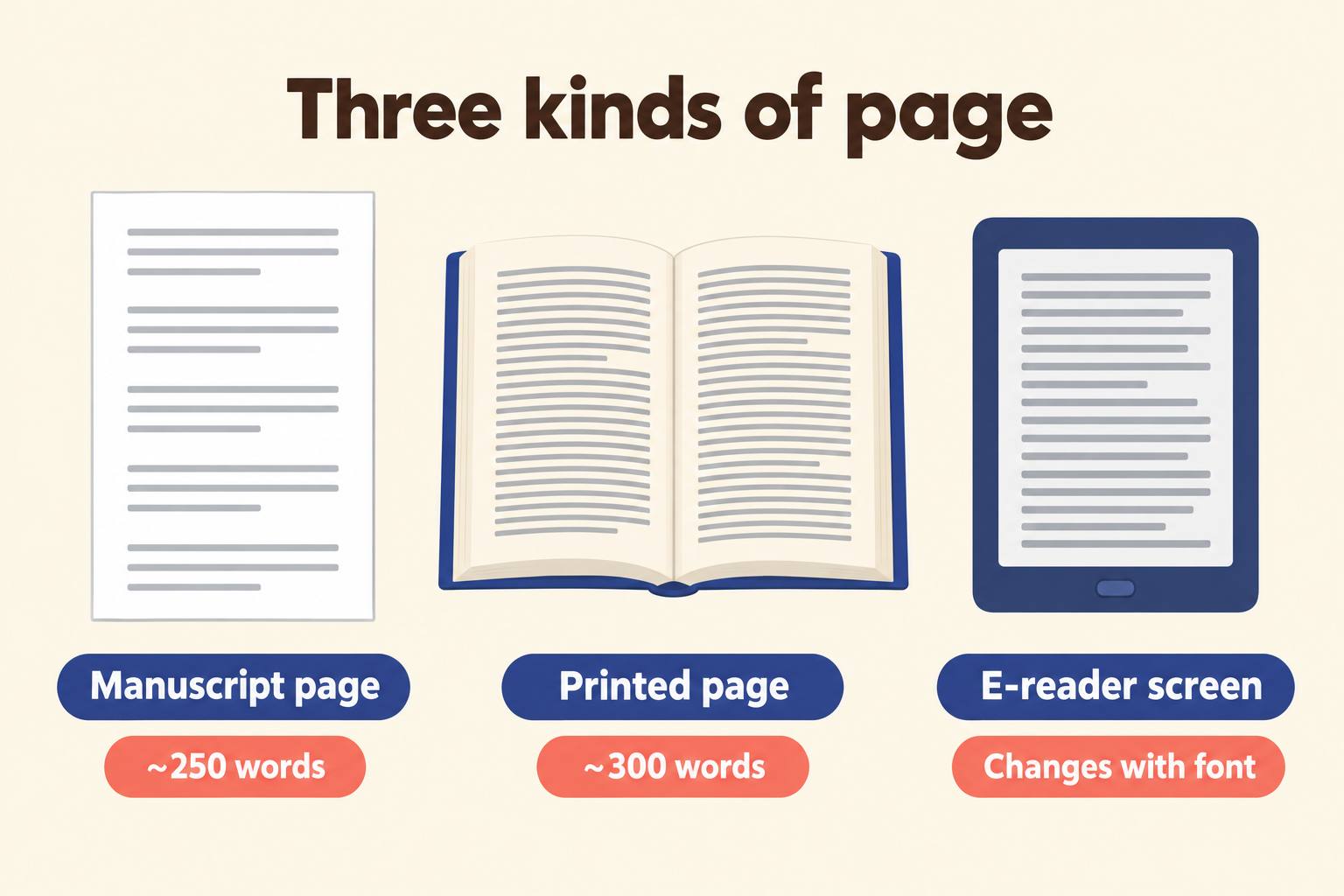
Manuscript page
The submission format: 12-point Times New Roman, double-spaced, one-inch margins on letter or A4 paper. The industry convention is 250 words per page, so an 80,000-word draft is about 320 manuscript pages. This is the page count in your word processor.
Printed page
A typeset page in a finished paperback. Smaller trim, single spacing and a book typeface put 250 to 400 words on it, and every front-matter page, blank verso and chapter opening counts toward the total.
E-reader screen
An ebook has no fixed pages. The reader picks the font and size, so one screen might hold 150 words or 400. Store listings show a print-length figure, and Kindle Unlimited pays on normalized KENP pages, but neither is a page the reader actually turns.
So a 400-page manuscript is not a 400-page book. After typesetting it usually shrinks by a quarter or more. If you want the per-page detail behind these numbers, our breakdown of how many words fit on one page walks through the variables one at a time.
Page count estimator
Enter your word count and pick the settings you expect to publish with. The estimate includes about ten pages of front and back matter and the extra space chapter openings take. Expect real typesetting to land within about ten percent.
Drag or type. Use your current draft or your target.
Estimated printed pages
282
- About 305 words per page
- 320 pages as a double-spaced manuscript
- Assumes about 20 chapters of roughly 4,000 words
What this means on Amazon KDP
- US print cost, black ink: about $4.38 (Regular trim rate)
- Spine width: 0.635 in. Long enough for spine text
- Within the KDP paperback range of 24 to 828 pages
- Fits the KDP hardcover range of 75 to 550 pages
Where this length sits
Inside the normal novel range for most genres.
Closest famous book by length: The Catcher in the Rye (~73,400 words)
KDP figures are from Amazon's published print specifications and cost formula for Amazon.com at the time of writing. Check KDP's own calculator before you set a price.
Famous novels, measured the same way
Page counts on product listings are useless for comparison, because every edition uses a different trim and typeface. A cleaner method is to take commonly cited word counts and run every book through the same settings. Here is what that looks like at 11-point medium type, standard spacing.
| Book | Words | 5.5 x 8.5 in | 6 x 9 in |
|---|---|---|---|
| The Old Man and the Sea | ~26,600 | 102 | 86 |
| Animal Farm | ~30,000 | 112 | 96 |
| Slaughterhouse-Five | ~49,500 | 178 | 150 |
| Lord of the Flies | ~60,000 | 214 | 180 |
| The Catcher in the Rye | ~73,400 | 260 | 218 |
| Nineteen Eighty-Four | ~89,000 | 312 | 262 |
| To Kill a Mockingbird | ~100,400 | 352 | 294 |
| Twilight | ~119,000 | 414 | 346 |
Page figures are our estimates under identical settings, not the page count of any particular edition. Your copy will differ, which is exactly the point.
Two things stand out. The first two books are novellas by word count, and publishers made them look substantial with generous type and wide margins. And Nineteen Eighty-Four, about 15,000 words longer than The Catcher in the Rye, would print at 262 pages at 6 x 9 while Catcher needs about 310 at 5 x 8. That shows how much of what a reader perceives as length is really formatting.
Novel pages by genre
Genre sets the word count range, and the word count sets the page count. These page ranges come from each genre's usual word band, using the same settings as the table above.
Middle grade is usually printed in larger type with more leading, so real middle-grade books run longer in pages than this table suggests.
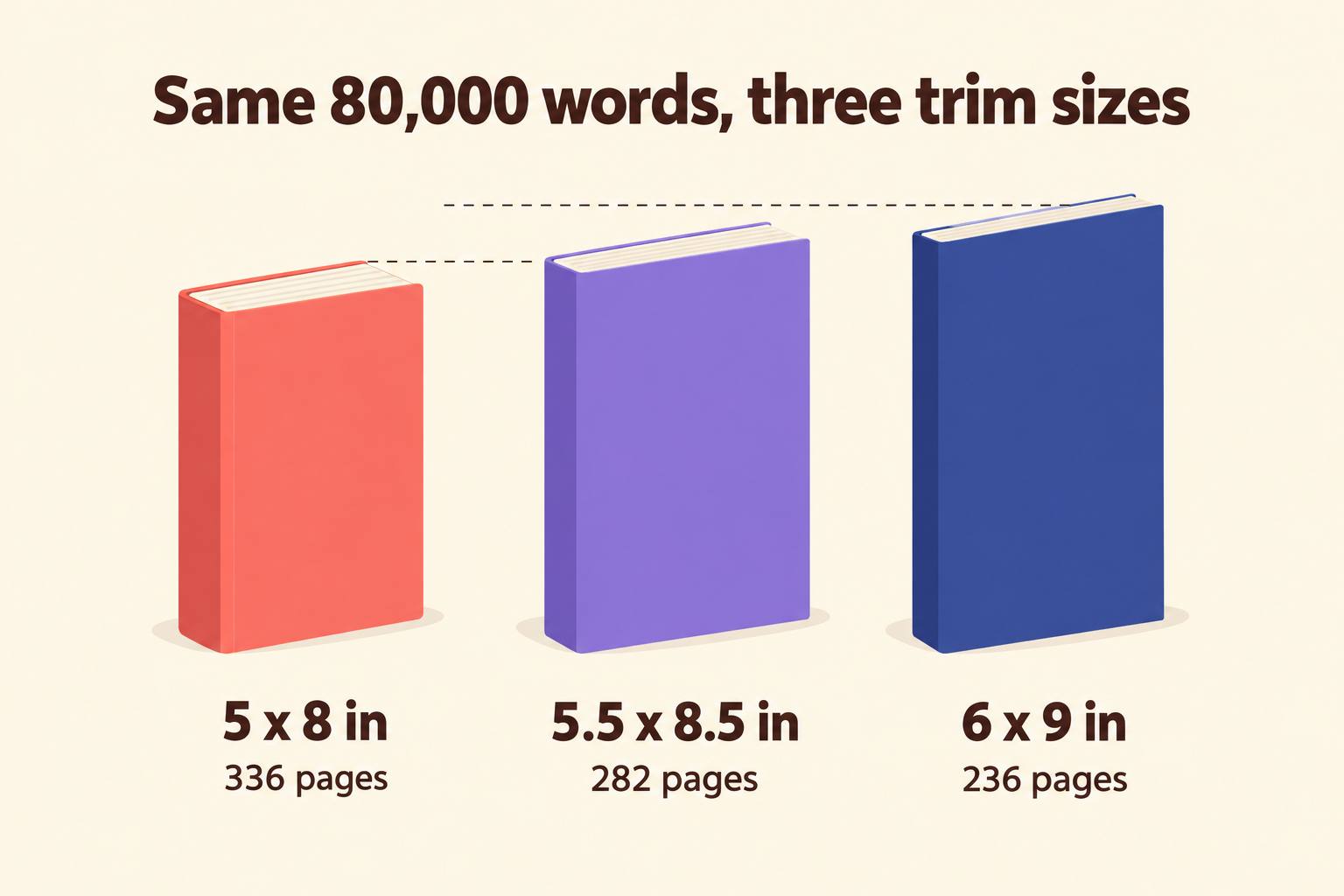
Trim size is the biggest lever
Moving from 5 x 8 to 6 x 9 cuts an 80,000-word novel by about 100 pages. On KDP's current US formula that also cuts roughly $1.20 off the print cost of every copy, which comes straight out of your royalty. If you are unsure what the sizes mean in practice, our note on what trim size means covers the common options.
Using page count while you write
Page count is a publishing number more than a writing number, but it is still useful at a few points in the process if you convert it correctly.
Planning chapters
If your chapters average 4,000 words, each one is about 13 printed pages at 5.5 x 8.5. That is a comfortable length for most commercial fiction. For genre-by-genre guidance, see how many pages a chapter should be.
Setting daily targets
Set daily goals in words. Three printed pages a day sounds modest, but it is roughly 900 words, and 900 words a day finishes an 80,000-word draft in about three months.
Querying agents
Never put a page count in a query letter. Agents read word count, rounded to the nearest thousand. A page figure suggests you do not know the convention.
Pricing a paperback
Print cost rises with every page, so page count sets the lowest list price that still pays you. Run your estimate through the royalty calculator before you settle on a trim size.
Common mistakes
- 1
Counting pages in the word processor
A 400-page double-spaced document is not a long novel. It is about 100,000 words, which is upper-mid range. Check the actual figure with our free word counter, which also estimates paperback pages.
- 2
Comparing your draft to a shelf copy
Holding your manuscript next to a published hardcover tells you nothing, since the two are set differently. Compare word counts instead.
- 3
Padding to reach a page target
Writers sometimes stretch a 55,000-word story to fill a page count they picked arbitrarily. Readers notice the drag well before they notice the length.
- 4
Ignoring the fixed pages
Title page, copyright, dedication, contents, acknowledgments, author bio and the blank pages that keep chapters on the right side can add 10 to 20 pages before a word of story is counted.
- 5
Picking a trim size at the end
Trim size changes page count, spine width, cover dimensions and print cost at once. Choose it before you commission or design a wrap cover, not after.
When page count matters and when it does not
It matters when you are
- Setting a paperback or hardcover price
- Designing a wrap cover, since spine width follows page count
- Checking printer limits, such as KDP's 75-page hardcover minimum
- Writing a product listing where readers compare lengths
Ignore it when you are
- Drafting, where word count and scene goals are better measures
- Querying agents or entering contests
- Deciding whether a story is a novel or a novella
- Planning an ebook-only release
The novel threshold is set in words. The common line is about 40,000, and the novella vs novel guide explains how the categories divide.
Where AI helps
Page count problems are mostly planning problems, and that is where AIWriteBook fits. When you plan a novel in the app, every chapter in the story bible has its own word count target, so you can shape an 80,000-word book as twenty 4,000-word chapters from the start instead of discovering the length at the end. The chapter generator writes each chapter against that target, and you can revise any passage in the chapter chat, accepting or rejecting each change.
When the draft is finished, book formatting gives you the real page count rather than an estimate. You choose a trim size and one of the body fonts, the print PDF is laid out to that page, and the wrap cover's spine width is calculated from the actual page count. You can switch from 6 x 9 to 5.5 x 8.5 and compare before you upload anything to KDP or IngramSpark.
Frequently asked questions
A 300-page double-spaced manuscript is about 75,000 words. Printed at 5.5 x 8.5 in 11-point type it comes to roughly 270 pages, and at 6 x 9 closer to 225.
At 5.5 x 8.5 a 200-page book holds roughly 55,000 words, which is short but acceptable for a novel in romance, cozy mystery and some young adult. At 5 x 8 the same 200 pages hold under 50,000 words, and the book starts to read as a short novel.
About 350 pages at 5.5 x 8.5 and about 294 at 6 x 9 with standard settings. In manuscript format it is around 400 pages.
Most commercially published novels print between 250 and 400 pages. Edition, trim size and typeface cause wide variation, so the same novel can differ by 100 pages between a mass-market paperback and a trade paperback.
In black ink on white paper, KDP paperbacks run from 24 to 828 pages. Hardcovers must be between 75 and 550 pages, and spine text needs at least 79 pages.
Not a fixed one. Readers change font and size, so the number of screens varies. Store listings show a print-length estimate, and Kindle Unlimited pays on normalized KENP pages.
The bottom line
Write to a word count and let the pages follow. Choose the word band your genre expects, plan your chapters inside it, and leave trim size and typeface for the formatting stage, when you can see the real page count and what it costs to print. If you are still at the start of the process, our How to Write a Book guide goes through every stage from idea to published book.