


In this guide
Why the scene has to earn its place
Romance readers do not skim intimate scenes because they are prudish. They skim because the scene is interchangeable: lift it out, drop it into another book, and nothing breaks. That is the test. If your scene could be swapped between novels, it is choreography, and choreography is boring at any heat level.
A scene earns its place when at least one character leaves it different from how they entered. Trust deepens, or cracks. A secret slips. Someone realizes this is no longer casual. In slow burn romance the first intimate scene often lands at the midpoint or later precisely because it has to pay off two hundred pages of restraint, and readers will forgive a lot except a payoff that changes nothing.
So before you decide how much to show, decide what changes. Everything else in this guide is technique for delivering that change.
The heat scale, by subgenre
Heat level is a promise to the reader, set by your subgenre, your cover, and your blurb before page one. Breaking that promise in either direction earns one-star reviews: a sweet reader ambushed by an explicit chapter, or a spicy reader who bought a book that closes the door every time. Pick a level and hold it.
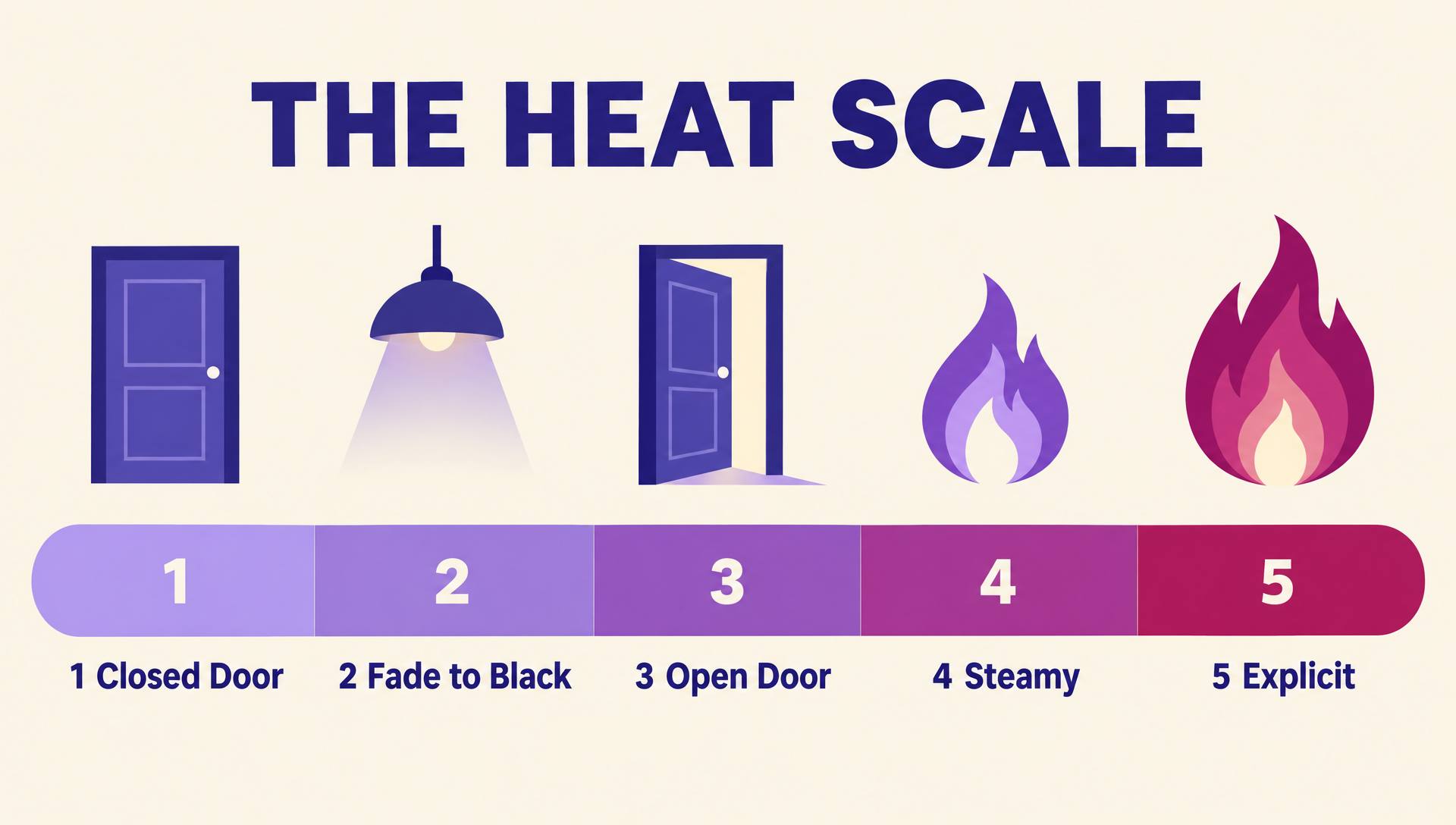
Tap a level to see what it looks like on the page and where it sells.
On the page
The scene stays on the page with sensory detail, but the language is restrained and the focus stays on emotion.
Typical subgenres
Mainstream contemporary, rom-com, much of historical and paranormal romance
What the reader expects
Two or three scenes per book, each tied to a relationship milestone.
If you are unsure where your book sits, read the top twenty titles in your exact Amazon subcategory and count. How many intimate scenes, how long, which chapter? That data beats any rule of thumb. Our romance tropes list is a useful second lens, since tropes like fated mates or forced proximity tend to cluster at specific heat levels.
The five beats of an intimate scene
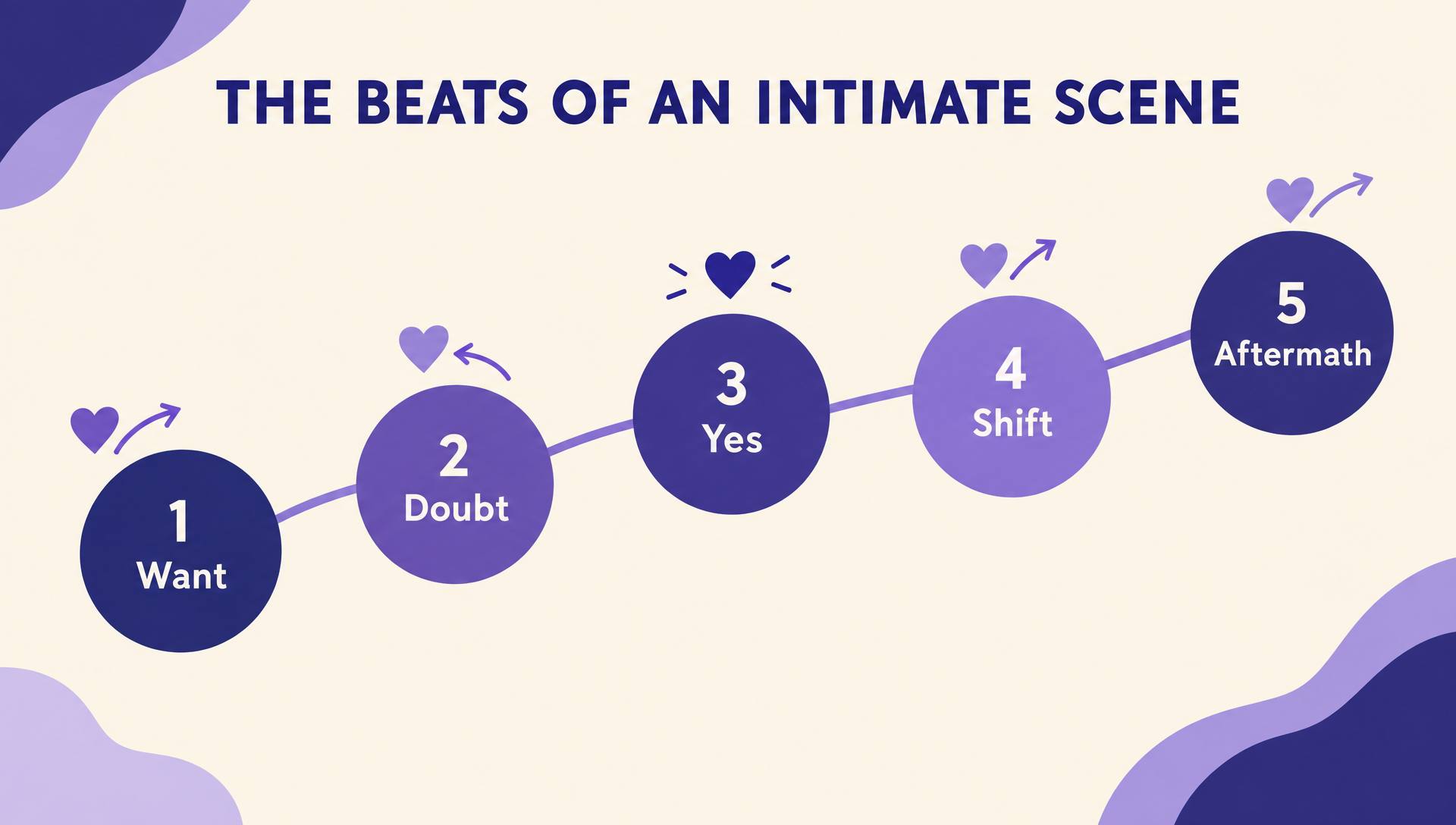
Almost every intimate scene that works, from a single kiss in a sweet romance to a full chapter in erotic romance, moves through the same five emotional beats. The heat level decides how much of beats three and four are on the page. It does not decide whether the beats exist.
- 1
Want
Establish desire through the point-of-view character's specific perception. Not generic beauty, but the one detail only this character would notice.
- 2
Doubt
Something in the way: a wound, a rule, a rival, a fear. Without resistance there is no tension, only logistics.
- 3
Yes
The choice. Both characters decide, clearly, in a way that fits who they are. This is where consent lives, and it is a character beat.
- 4
Shift
The emotional turn mid-scene: vulnerability, surprise, a confession, a moment one of them did not plan for.
- 5
Aftermath
What it costs or changes. The aftermath is often the most important page, and the one most writers rush.
Notice that the beats map onto ordinary scene structure: goal, conflict, decision, reversal, consequence. An intimate scene is a scene. When you outline it with a tool like the scene builder, give it the same goal and conflict fields you would give a confrontation.
Consent as character, not paperwork
Modern romance readers expect consent on the page, and many writers worry it will kill the mood. It only does that when it is written as a form being signed. Written well, the way a character asks and the way the other answers is some of the most revealing dialogue in the book.
A guarded hero who asks a direct question is showing a softness he hides everywhere else. A heroine who answers with a joke is telling the reader how she handles vulnerability. A character who says yes and then adds a condition is drawing a boundary that the relationship will have to honor later. Each of these is characterization doing double duty.
Three ways consent reveals character
The direct question
"Tell me to stop and I will." "I'm not going to tell you to stop."
Clean, confident, mutual. Works for a couple who has already been honest with each other.
The deflection
"Is this a good idea?" "Absolutely not. Come here."
Humor masks nerves. The yes is clear, and the deflection tells the reader she knows the risk.
The condition
"Yes. But I'm not staying the night."
A boundary that sets up the next act. When she does stay, two chapters later, it means something.
Dark romance and some erotic subgenres play with dubious consent as a fantasy element. If you write there, the convention is explicit content warnings up front and a clear frame that the characters, and the reader, opted in. Sensitivity and beta readers are worth their weight here; our guides to sensitivity readers and finding beta readers cover how to brief them.
Vocabulary: choosing a register
Word choice is where most intimate scenes go wrong, and the fix is not a list of banned words. It is choosing one register and staying in it. Every scene sits in one of three registers, and the cringe comes from switching between them mid-paragraph.
| Register | How it reads | Where it fits |
|---|---|---|
| Clinical | Anatomical, precise, cold. | Almost nowhere, unless the point-of-view character is a doctor and the coldness is the point. |
| Euphemistic | Metaphor and indirection. Easily tips into purple prose. | Closed door through open door, historical voice, when used sparingly and concretely. |
| Plain vernacular | The words the character would actually think. | Steamy and explicit, contemporary voice, deep point of view. |
The rule underneath the table: use the words your point-of-view character would use in their own head. A buttoned-up Regency heroine and a foul-mouthed hockey player do not share a vocabulary, and the reader notices when the narrator suddenly sounds like someone else. If your euphemisms start sounding like greeting cards, our guide to purple prose has the cure.
Before and after: the same moment, rewritten
Generic
A wave of desire washed over her as he looked at her with burning eyes.
Specific
She lost the end of her sentence. He waited for it anyway, which was worse.
The rewrite has no adjectives about desire at all. It shows desire through what it does to her and how he responds, which also tells you something about him: he is patient, and he knows exactly what he is doing.
Pacing and placement in the book
Inside a scene, pacing follows the same rule as action: short sentences speed things up, long ones slow them down, and you control the reader's breath with paragraph length. Slow down at the emotional shift, not at the physical peak. The moment a character drops their guard deserves more words than anything their hands are doing. Our guide to pacing in fiction covers these sentence-level levers in depth.
Across the book, placement matters as much as content. A useful pattern in open-door contemporary romance: a near-miss around the 25 percent mark, the first full scene near the midpoint, a scene that goes emotionally wrong or gets interrupted before the dark moment, and a final scene that confirms the relationship after the grand gesture. Steamy books add more scenes, but the escalation logic is the same: each one should be emotionally hotter than the last, not only physically.
Map every intimate scene onto your outline before drafting. If two sit in adjacent chapters and do the same emotional job, merge them or cut one.
Set the heat once and let the outline carry it
AIWriteBook lets you enable explicit content per book, pick content warnings, and set how much of each chapter is intimate in the outline, so your heat curve is planned before a word is drafted.
The cringe checklist
Run your draft against these before a beta reader sees it. Tick each one you have already checked.
KDP rules for adult content
Amazon KDP publishes romance at every heat level and has dedicated erotica categories, but its content guidelines draw lines you need to know before you upload. Amazon does not accept pornography or offensive depictions of graphic sexual acts, anything that sexualizes minors is banned outright, and Amazon has a long history of removing taboo-themed erotica. Read the current KDP Content Guidelines yourself before publishing, because Amazon applies them at its own discretion.
The more practical issue for most romance authors is the adult filter. Books Amazon classifies as adult are hidden from general search results and bestseller lists, which can quietly cut visibility for a book that is really mainstream steamy romance. Classification looks at the whole package, not just the text:
- Cover
- No nudity and no sexually suggestive poses on the cover. Steamy romance sells fine with discreet covers, illustrated couples, or object covers.
- Title, subtitle, and description
- Keep explicit words out. Heat can be signalled with genre language readers search for, such as steamy, spicy, or open door.
- Keywords
- The seven keyword slots must describe the book honestly. Use trope and heat terms readers actually type, not explicit phrases.
- Categories
- Choose erotica categories only if the book is erotica. A steamy contemporary romance belongs in contemporary romance subcategories, where it competes for visibility normally.
- Adult content question
- KDP's details page asks whether your book contains adult content. Answer honestly; a mismatch with the actual content is what gets books flagged later.
Choosing the right subcategory is easier with real data. The KDP category finder and KDP keyword research tool show you where comparable steamy romances actually sit, so you can match their shelf instead of guessing.
The AI-assisted shortcut
Most general-purpose AI chat tools refuse romance at any real heat, which leaves romance authors either fighting refusals or writing every scene by hand. AIWriteBook was built with romance in mind, so heat is a book setting rather than a fight.
1. Set the heat at book level
On the Details step, turn on Enable Explicit Content and pick the explicit elements or content warnings that apply. For closed-door books, leave it off and the chapters stay clean.
2. Distribute it in the outline
Each chapter in the story bible has an Explicit Content percentage. Set the midpoint chapter higher and the setup chapters at zero, and your heat curve is planned before drafting. The outline builder fills events and character interactions alongside it.
3. Pick the model for the scene
In the chapter editor you can choose Gemini, Claude, or Grok. Grok is the strongest for explicit chapters, while Claude tends to write the most polished prose for open-door scenes.
4. Steer with instructions, then edit
Use Additional Instructions To AI for scene-level direction, such as fading to black at the bedroom door or keeping the register plain. Then revise line by line with the chapter AI chat, accepting or rejecting each suggested change.
Because the book stores your characters, their motivations, and your writing style, the intimate scene draws on the same voice and the same relationship history as every other chapter. If you write erotic romance specifically, the page for erotica writers walks through that workflow, and the romance writers page covers the full romance setup.
Scene planning template
Copy these questions into your notes before drafting each intimate scene. If you cannot answer the first two, the scene is not ready to write.
- 1.What changes between them by the end of this scene?
- 2.What has been stopping them until now?
- 3.Whose point of view, and what does only this character notice?
- 4.How does each character say yes, in their own voice?
- 5.What is the emotional shift in the middle of the scene?
- 6.Heat level for this scene (1 to 5), and is it consistent with the book's promise?
- 7.Which register: euphemistic or plain vernacular?
- 8.What does the aftermath cost or set up in the next chapter?
Frequently asked questions
It depends on heat level. Closed-door books have none on the page, open-door contemporary romances usually have two to four, and steamy romances often have five or more. Check the top sellers in your exact subcategory for the real benchmark.
In most open-door romances the first full scene lands around the midpoint, after a near-miss earlier. Slow burns push it later. The scene should resolve tension that has been building, so placing it too early leaves nothing to pay off.
Yes. Mainstream steamy romance is published on KDP every day. Keep the cover non-explicit, keep explicit words out of the title, description, and keywords, choose romance subcategories rather than erotica unless the book is erotica, and answer KDP's adult-content question honestly.
Write it as dialogue that reveals character. How someone asks and how the other answers shows confidence, humor, nerves, or boundaries. Consent written in a character's own voice adds tension rather than removing it.
Use the words your point-of-view character would think, and stay in one register for the whole scene. Euphemism suits historical and closed-door voices; plain vernacular suits contemporary steamy and explicit books.
The short version
Decide what changes, then decide how much to show. Pick a heat level your subgenre promises and keep it. Write consent in your characters' own voices, choose one register, slow down at the emotional shift, and give the aftermath room. Then package the book so Amazon shelves it where your readers are looking.
For the craft around these scenes, from tension curves to tropes and how to write a romance novel start to finish, see our Genre Fiction guide.