

Step 1
Pick a concept that is bigger than "my recipes"
"Recipes I like" is a folder, not a book. A cookbook sells on a promise that fits in one line: what kind of food, for whom, and why this book instead of a free recipe site.
Answer these four questions before you write a single recipe. If you cannot, the book will drift.
- Who is cooking?
- A new parent with twenty minutes, a weekend baker, someone who just went gluten-free. One reader, described in detail.
- What problem does the book solve?
- Weeknight dinners without a supermarket run, a family's recipes saved before they are lost, plant-based food that feeds teenagers.
- What is your angle?
- Your grandmother's village, your restaurant, your one-pan method, your training as a nurse. The part only you can write.
- How big is it?
- A tight collection is easier to test, photograph and finish. A focused book you publish beats a huge one that never ships.
Family cookbooks work on the same rules, even if the readers are your cousins. The concept is the family, the angle is the stories, and the promise is that nobody loses the recipe for the Sunday stew.
Step 2
Organize the chapters the way your reader cooks
Readers flip, they do not read front to back. Your chapter order is a map, so choose the one that matches how your reader decides what to make tonight.
By course
Breakfast, mains, sides, desserts. Familiar and easy to navigate. Best for general home cooking.
By season
Spring to winter, built around what is fresh. Best for garden, farm and local food books.
By technique or time
One pan, slow cooker, fifteen minutes, make ahead. Best when the method is the promise.
By occasion or story
Holidays, family members, places. Best for family and heritage cookbooks.
Add the front and back matter readers expect: a short introduction to your approach, a pantry or equipment chapter if the book relies on them, and an index by ingredient. A reader holding half a cabbage wants to know what to cook with it.
Step 3
Write recipes that work in someone else's kitchen
A recipe is a set of instructions for a stranger. Everything you do without thinking, they need written down: the pan size, the heat level, what "done" looks like.
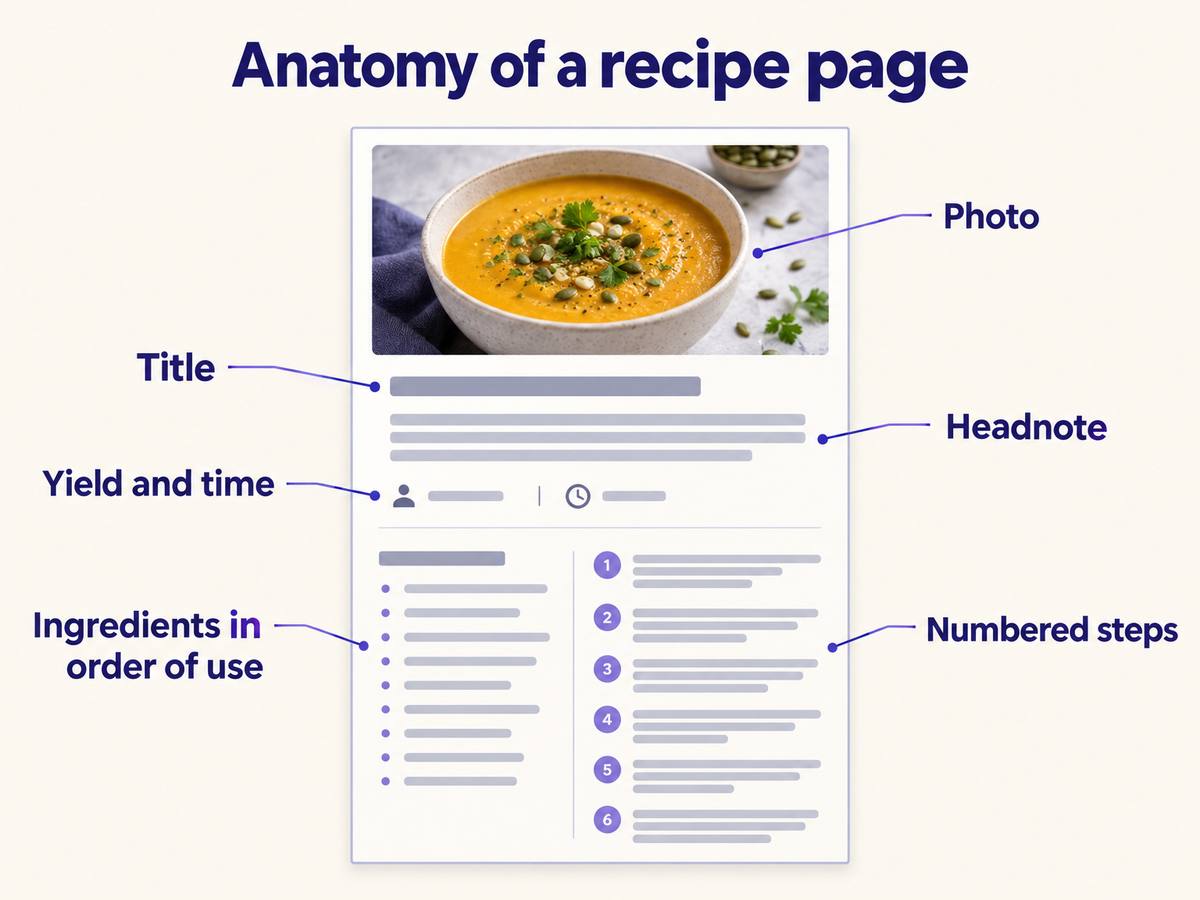
Your recipe style sheet
Decide these once and apply them to every recipe. Consistency is what makes a cookbook feel professional.
| Element | The rule to set | Example |
|---|---|---|
| Title | Say what the dish is. A clever name needs a plain subtitle. | Sunday Stew (Beef and Barley with Thyme) |
| Yield and time | Servings or quantity, plus prep and total time. | Serves 4. Prep 20 min, total 2 h |
| Ingredients | List in the order they are used. Put the prep after the ingredient. | 1 onion, finely chopped |
| Units | Pick cups or grams (or both) and never mix systems mid-book. | 200 g (1 1/2 cups) flour |
| Steps | Numbered, one action per step, with a sensory cue for done. | Cook until the onion is soft and golden, about 8 minutes. |
| Temperatures | Give both scales if you sell in more than one country. | Bake at 180°C (350°F) |
| Notes | Storage, swaps and make-ahead tips go after the steps. | Keeps 3 days in the fridge. |
Test every recipe, then have someone else test it
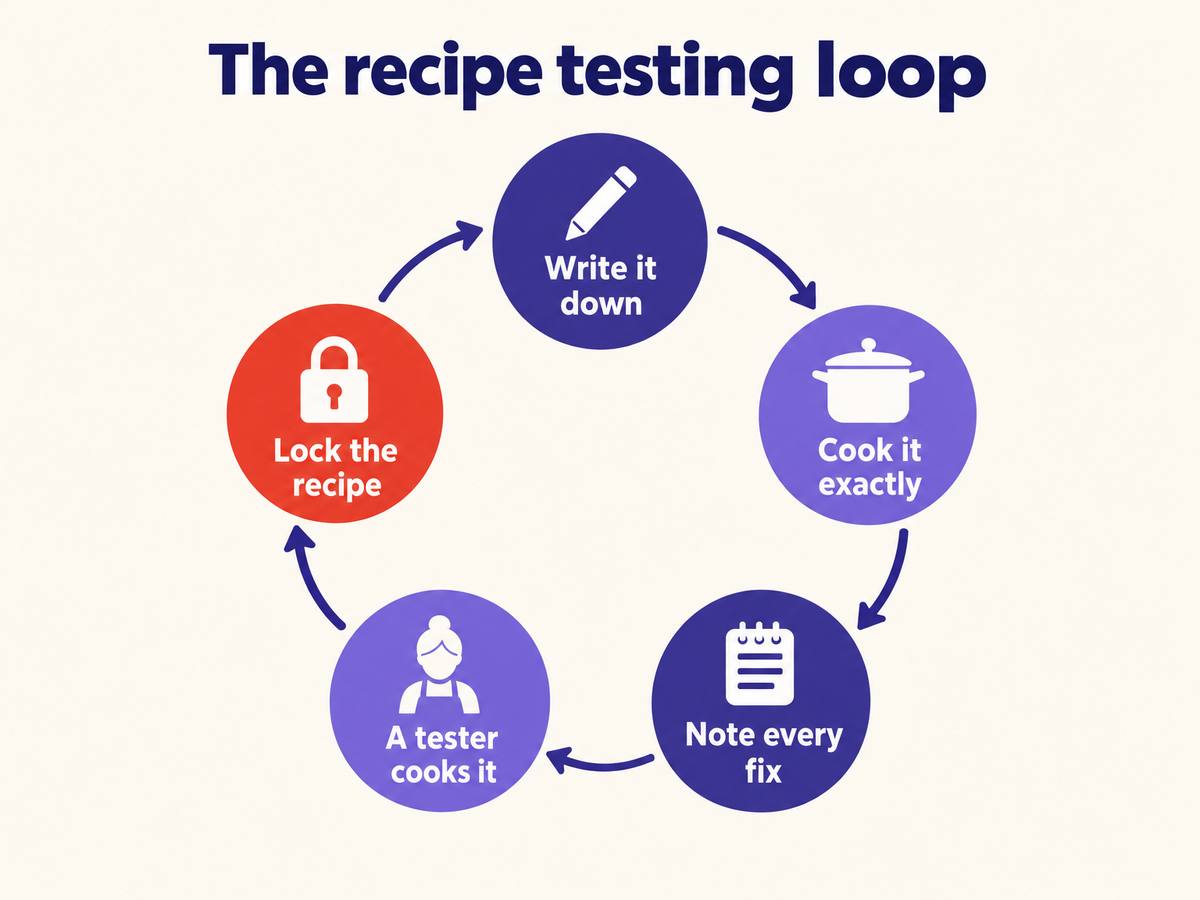
Cook each recipe exactly as written, not as you remember it. Every time you add a pinch the text does not mention, that is a missing line.
Then hand it to a tester who has never seen you make it, ideally someone who cooks like your target reader. Ask them to note where they hesitated, what they had to guess, and how long it really took. Fix the text, not their cooking.
Only lock a recipe when a tester gets the result you expect from the words alone.
Step 4
Write headnotes that make people want to cook
The headnote is the short paragraph between the title and the ingredients. It is where your voice lives, and it does three jobs: tells the reader why this recipe is worth making, gives one tip that helps it succeed, and connects it to you.
Keep it to a few sentences. Use the senses, the smell of the onions, the crackle of the crust, the way five senses in writing works for novelists works at the stove too. Then cut every word that does not earn its place, as in how to write tighter prose.
Before
This is a really delicious stew that my family has always loved. It's very easy to make and it's perfect for cold days. I hope you enjoy it as much as we do!
See the rewrite
After
My grandmother made this every Sunday in October, and the whole stairwell smelled of thyme by noon. The trick is patience: let the beef brown properly before the barley goes in, and the broth turns rich without any stock cube.
The rewrite gives a picture, a place in time and one real tip. "Delicious" and "easy" are claims; the second version shows them.
Step 5
Plan the photos before you shoot
Photos sell cookbooks, and they also cost the most time. Decide early whether every recipe gets a photo, or only the hero dishes plus a few process shots for the tricky steps.
A phone and good window light are enough to start. Shoot in daylight, turn off overhead lights, keep backgrounds plain, and cook the dish for the camera, slightly underdone vegetables look fresher.
A simple shot list per recipe
- One finished-dish photo, shot from the same angle style as the rest of the book
- Process photos for any step a beginner could get wrong
- Space for chapter openers and the cover, planned in the same style
If you want illustrations instead of photos, or a consistent visual style across every page, AIWriteBook's Visual Books creator includes a cookbook genre and keeps one art style through the whole book.
Step 6
Format for print: ink, trim and bleed
Cookbooks live on the kitchen counter, so most authors want print. On Amazon KDP, the biggest choice is the ink, because it decides your format options and your page count rules.
| KDP ink option | Paperback | Hardcover | Good to know |
|---|---|---|---|
| Black and white (cream or white paper) | Yes | Yes | Photos print in grayscale. Fine for text-led family cookbooks. |
| Standard color (white paper) | Yes | No | Needs at least 72 pages. |
| Premium color (white paper) | Yes | Yes | Allows books from 24 pages. KDP's top color option for photos. |
KDP hardcovers run from 75 to 550 pages, and you cannot change the ink type after the book is published, so decide before you upload.
If photos run to the edge of the page, your file needs bleed: 0.125 inches extra on the outside edges. Pick your trim size before layout, since changing it later reflows every page. For the full upload checklist, see how to format a book for KDP.
Step 7
Self-publish on Amazon KDP
With the files ready, publishing is mostly paperwork. Work through it in this order:
- 1A clear title and subtitle that say what the food is. The free title generator helps if you are stuck.
- 2A copyright page with your rights notice and any recipe credits.
- 3An ISBN. KDP offers a free one, or you can buy your own; see how to get an ISBN.
- 4A book description that sells the promise, not a list of recipes. Draft it with the blurb generator.
- 5Categories that match the cuisine or diet, found with the category finder.
- 6A cover that reads at thumbnail size, with the food as the hero.
Order a printed proof before you go live. Color, margins and photo quality look different on paper than on screen.
Step 8
Use AI for the heavy lifting, keep the cooking yours
AI cannot taste your stew, but it can take the writing load off. In AIWriteBook you can start a non-fiction book with Cookbook as the genre and add up to ten reference files, such as your recipe notes, a family document or a typed-up recipe box.
Use it to draft the introduction, chapter openers and headnotes from your notes, then rewrite them in your voice. A custom writing style keeps every headnote sounding like you.
When the text is done, the book formatter exports a print PDF and EPUB at nine trim sizes. If you want a fully illustrated book, the Visual Books creator builds cookbook pages in one locked art style and exports a print-ready PDF with bleed.
Test every recipe yourself. AI drafts the words; only a stove proves the recipe.
Common cookbook mistakes
- Ingredients out of order
- The cook reads top to bottom. An ingredient that first appears in step 6 but sits at the top of the list causes mistakes.
- Untested quantities
- Halving or doubling a recipe on paper without cooking it. Baking times and seasoning do not scale in a straight line.
- Vague cues
- "Cook until done" means nothing to a beginner. Give a time and what to look, smell or listen for.
- Too many recipes, no promise
- Volume does not sell a cookbook. A clear concept does. Cut recipes that do not serve the reader you picked.
- Choosing color ink too late
- Ink type sets your page minimum and price, and it cannot be changed on KDP after publishing.
Frequently asked questions
How many recipes should a cookbook have?
There is no fixed number. Let the concept decide: a focused book on one technique can be short, a family collection can be longer. Every recipe should be tested and serve the reader you picked.
Can I publish recipes I found online or in other books?
A plain list of ingredients is not protected by copyright in the U.S., but the headnotes, method text and photos are. Write your own version in your own words, use your own photos, and credit the source when you adapt a recipe.
Do I need professional photos?
No. Many self-published cookbooks use phone photos taken in good daylight, and some use illustrations instead. What matters is a consistent style across the book.
Should my cookbook be printed in color?
If photos are central, yes. On KDP, standard color is paperback only and needs at least 72 pages, while premium color works for paperback and hardcover from 24 pages. A text-led family cookbook can print in black and white.
How do I make a family cookbook?
Collect the recipes and the stories behind them, test each one in a modern kitchen, write short headnotes about who made it and when, and organize by person or occasion. Print a few copies through KDP or another print-on-demand service.
Can AI write my cookbook?
AI can draft the introduction, chapter text and headnotes from your notes, and help with titles, descriptions and layout. The recipes themselves need to be yours and tested in a real kitchen.
Start with ten tested recipes
Write the one-line promise, choose the chapter order, and test ten recipes properly before you write the rest. That small batch sets your style sheet, your headnote voice and your photo look, and the rest of the book follows the pattern.
Writing a different kind of book next? The full guide to how to write a book covers every genre, and the non-fiction book writing guide goes deeper on structure. Short on time? Read how to write non-fiction fast.